
The historical period spanning the 17th — first half of the 18th century played an important role in the history of the peoples of Eurasia. However, if for Europeans its main events were the Thirty Years’ War, the English Revolution, military conflicts with the Ottoman Empire, the Russian-Polish Wars, the Great Northern War, the War of the Spanish Succession, etc., then for inner Eurasia this period is rightly referred to as the era of the «Small Mongol (Oirat) Invasion.»

The Oirat Khanate in 1415

A fragment of a map of the Russian Empire and nearby states from the time of Peter the Great. The Oirat Khanate is green
During this period, the Oirats, Mongol-speaking nomads, turned their expansion to the west and south after being defeated in a long confrontation with the Hotogoyt and Khalkha khanates of the Mongols.
The area of military activity of the Dzungars, as the union of Oirat tribes is otherwise called, included vast expanses of inner Eurasia from the Black Sea steppes in the west to Tibet in the east and from the forests of Western Siberia in the north to the deserts of Transoxiana in the south.
As a result of the first stage of the «Small Mongol Invasion» in Eurasia, four main Oirat military and political groups were formed: «Kalmyk» — in the Northern Caspian region, «Chakar» — in Northern Kazakhstan and southern regions of Western Siberia, «Khoshut» — in Tibet and «Dzungarian» — in western Mongolia, southeastern Kazakhstan and Sayano-Altai.
In the first half of the 18th century, the Jungar Khuntaijs controlled a significant part of Central, Southern and Southeastern Kazakhstan, almost all of East Turkestan and the Altai Mountains.
The Western Oirats (Volga Kalmyks) became one of the main allies of the Russian state in the wars with the Crimean Tatars and Nogai. Kalmyk detachments repeatedly invaded Crimea and the lands of the Circassians, fought on the territory of Right-bank and Left-Bank Ukraine, in the Black Sea steppes, in the Kuban and in the steppes of Western Kazakhstan.

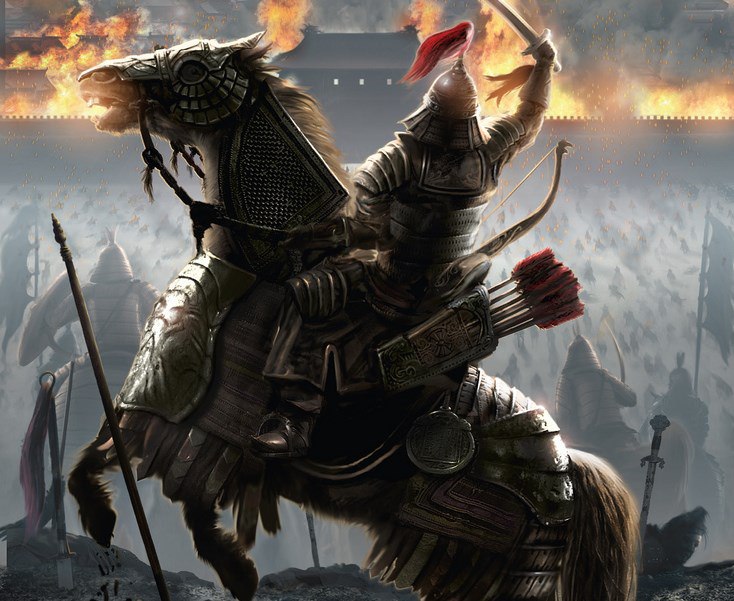
Oirat (Kalmyk) warriors of the XVII-XVIII centuries
The Great Nogai Horde fell under the blows of the Kalmyks. The Kalmyks also made a very significant contribution to the victories of the Russian army over the troops of the Crimean Khanate and its allies in the military conflicts of the first half to the middle of the XVIII century. From the second half of the 17th century until the beginning of the 19th century, the Kalmyk cavalry took an active part in Russia’s wars against the mighty European powers — the Polish-Lithuanian Commonwealth, Sweden, Prussia, and France.
The military successes of the Oirats were due to a whole range of reasons, not the least of which was the advanced weapons system and effective combat tactics. One of the characteristic elements of the Oirat military practice was the widespread use of long-bladed (spear) and firearms.
The main rival of the Oirats in the western part of the Great Steppe was originally the Great Nogai Horde. On the eve of the Oirat invasion, she was going through hard times. The military potential of the once «innumerable» Nogai was significantly reduced as a result of civil strife, famine and migration, nevertheless, they continued to be a very formidable and dangerous enemy.

Oirat (Kalmyk) warriors of the XVII-XVIII centuries
The course and results of the Nogai-Oirat military conflicts of 1607-1634 caused all the more surprise to contemporaries. The very first military clashes showed that the Nogai had nothing to oppose the militant aliens from the East. Following the Huns, ancient Turks, and Mongols, the Kalmyks in the first half of the 17th century were able to demonstrate to the local nomads the advantages of the Central Asian military system.
The armies of Kho-Urlyuk and other Oirat Taish confidently defeated the Nogai militias over and over again and went from victory to victory. The attempt of the Horde nobility to form an effective anti-Kalmyk alliance with the participation of Moscow and Bukhara failed.

Oirat (Kalmyk) warriors of the XVII-XVIII centuries.
In 1632, the vertical «tailed» banners of the Oirats, unusual for these places, had already risen above the Volga. And two years later, the Big Nogai Horde on the eastern bank of the great river was finished. Now the sharpness of the Oirat weapons was to be tested by the Nogai of the Little Horde, and then by the Crimean Tatars, who had long been accustomed to consider the Black Sea steppes their undisputed patrimony.
The collapse of the Great Nogai Horde was the result of a series of political, socio-economic and military reasons. The Oirat military art, unusual for the nomads of the western steppes, played an important role in this. Streletsky head Ivan Boltin reported to Moscow in 1631 that the Nogai simply did not know how to fight the Kalmyks.:
«they, the Kalmyk people, are much more terrible than the Nagai people, and they have not flocked against them, and they do not know how to fight them anywhere.»
The Oirat cavalry made no less impression on the Crimean Tatars. Having suffered a series of serious defeats, the Crimeans began to avoid close combat with the Kalmyks. Chigirinsky Colonel Grigory Karpovich wrote enthusiastically in 1677.:
«Kalmyks Tatarov and Turks boyatts… And if… the Kalmyks are sent to Ukraine, and the Tatars know them, and when they see them, they won’t fight them, they’ll run away.»

The Cossack Hetman I. S. Samoilovich, in a letter dated March 6, 1678, specifically asked the Russian command to send Kalmyks, claiming that
«and even if there were not more than two thousand people, it would be… a lot of them would be corrected by the enemy of fear.
The papal nuncio, who accompanied Jan Sobieski’s Polish army during the 1684 campaign, reported admiringly about the Kalmyks:
«If there were many of them, the Perekop Tatars, who, like the Turks, are their sworn enemies, would have been quickly exterminated. They are so brave, so skilled with the saber (szabli) and bow (luhku), and have such superiority over the Tatars that one Kalmyk would not hesitate to attack ten Tatars. Their very name is so terrible to them that wherever their voice is heard, they run in great disorder if they do not want to test the strength of their iron and the accuracy of their bows… If several thousand of them could be brought, they would be of great help in the war of Christians against the basurmans.»

The Oirat cavalry of the XVIII century.
Peter I also praised the Kalmyk cavalry in a conversation with the Danish envoy Justus Julius on March 11, 1711.:
«Here [the tsar] informed me that 40,000 Kuban Tatars wanted to attack his fleet near Azov, but that they were driven away by the Kalmyk Khan with ten thousand Kalmyks, because the Kalmyk Tatars are much more warlike and (stronger) than other Tatars. Thus, the great fears about the (capture by the Kuban) Tatars of the Tsarist fleet disappeared.»
Even the Ottoman traveler E. Celebi had to admit the military superiority of the Oirats, who bitterly stated that «the Kalmyks always return, beating the Krymchaks.»
During the entire 17th century, the Nogai managed only once to inflict a serious defeat on the Oirat troops. This happened in 1644, when the Nogai, Kabardians and Tatars lured the army of Kho-Urlyuk into a mountain gorge, where they were attacked by rifle fire from riflemen entrenched on the slopes of the mountains. However, this exception only confirmed the general rule.
The Allies gained the upper hand by fighting the Kalmyk cavalry on rough terrain (where they lacked room for maneuver), using ambushes and firearms. As for the battles with the troops of the Turkic nomads of the region in the steppe theater of operations, the Oirats had no equal in them until the end of the century.