
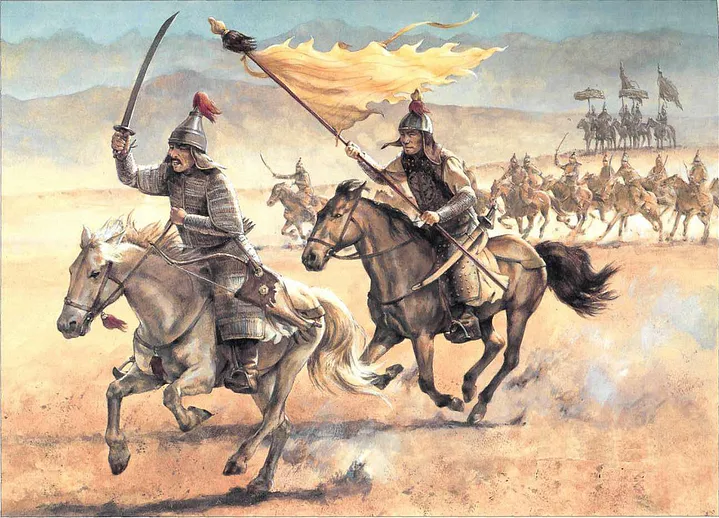
November 24, 1221. The bank of the Indus River is the place where one of the most dramatic epics of the Middle Ages ended. On one side — the rushing water, on the other — the rocks, and on the third — a hundred thousand horsemen of the most effective military machine in the history of mankind.

At the center of this nightmare was a young man named Jalal al-Din Menguberdi. The last sultan of Khorezm, the heir to an empire that a couple of years ago stretched from India to Anatolia, and now has shrunk to the size of a patch of land under the hooves of his horse.
It wasn’t just a battle. It was the finale of a personal vendetta, a clash of two wills and two worlds. Genghis Khan, the Shaker of the Universe, came here personally to put an end to the «Khorezm issue.» But what happened next made even the old Mongol, who had seen the sights, take off his hat as a sign of respect.
Today we will talk about how one man tried to stop an avalanche, why a quarrel over a horse can ruin an empire, and what a real leap of faith looks like.
Anatomy of a disaster
To understand how Jalal al-Din ended up in such an unenviable position, you need to rewind the film a couple of years ago.
In 1219, Khorezm was a superpower. Sultan Ala al-Din Muhammad II (our hero’s father) ruled vast territories, had an army of 400,000 men, and considered himself the second Alexander the Great. When envoys from some steppe chieftain came to him with an offer to trade, he overreacted, to put it mildly. The ambassadors were executed, and the caravan was looted. It was a mistake that historians would later call «the most expensive suicide in history.»
Genghis Khan responded not just with war, but with total annihilation. The Mongols marched through Central Asia like a knife through butter. Otrar, Bukhara, Samarkand — the cities fell one after another. Sultan Mohammed, instead of giving a general battle, dispersed his troops among the garrisons (a classic mistake of a dictator who fears his own generals more than the enemy) and went on the run. He died on an island in the Caspian Sea, abandoned, sick and in rags.
Power passed to his eldest son, Jalal al-Din. The guy was from a different background. If the father was a politician and a schemer, then the son was a warrior. But his legacy was, frankly, so-so: a destroyed country, a demoralized army, and a bunch of relatives who hated him for his mother’s Turkmen heritage (racism is an ancient thing).
Parwan: A moment of glory and shame
Jalal al-Din was not going to give up. With a handful of loyal men (300 sabers in total!) he breaks through the Mongol cordons and goes to Afghanistan, to the city of Ghazni. There he gathers under his banners all those who are still ready to hold the sword: Turkmens, Afghans, remnants of Khorezmians.
And then a miracle happens. In the Battle of Parwan, Jalal al-Din inflicts a crushing defeat on the Mongols. He defeats the 30,000-strong corps under the command of Shigi-Kutuku, the adopted brother of Genghis Khan himself.
For the first time in many years, the myth of the invincibility of the Mongols has been dispelled. The captured Mongols said that their commanders were ordinary people, not demons. It would seem that this is the turning point!
But then human stupidity comes into play. After the victory, the military leaders of Jalal al-Din (those «loyal vassals») quarreled when dividing the spoils. The stumbling block was the thoroughbred argamak (horse). Two emirs, Amin al-Mulk and Seif al-Din Agrak, did not share the horse. One word at a time, and Seif al-Din, offended, led his troops away — and that, for a moment, is 30,000 people, a third of the army!
Jalal al-Din begged them to stay, wept, tore off his turban, but the pride of the field commanders turned out to be stronger than the instinct of self-preservation. The army broke up.
Hunting the wolf
After learning about the defeat at Parvan, Genghis Khan did not tear his hair. He simply gathered all available forces (according to various estimates, from 80 to 100 thousand) and personally led the chase. «I’ll do it myself,» the Great Khan decided.
The Mongols marched in a forced march, sweeping away everything in their path. Jalal al-Din, realizing that he could not stand with the remaining forces (about 30 thousand), decided to leave for India. Beyond the Indus, he hoped to catch his breath and raise a new army.
But Genghis Khan was faster. He overtook Khorezm Shah on the banks of the river, in an area that is now located on the territory of Pakistan. The trap snapped shut.
Jalal al-Din’s position was desperate, but tactically sound. He formed his troops into a crescent: the left flank rested on the inaccessible mountains, the right on the bend of the river. There was nowhere to retreat to (the fleet was not ready for the crossing yet, and the storm had battered the ships), but it was difficult to outflank it. All that remained was to fight to the death.
The Battle of the Rocks
The battle began at dawn on November 24. Genghis Khan, with triple numerical superiority, was in no hurry. He put the best forces (Keshik, personal guard) in reserve, and sent his allies and light cavalry ahead.
The Mongols attacked the flanks. On the right flank of the Khorezmians, commanded by the same Amin al-Mulk (the culprit of the quarrel over the horse), things were going badly. The Mongols were pushing him towards the river. But on the left flank, in the mountains, the Khorezmians held on tightly.
Jalal al-Din, seeing that passive defense leads to death, decided on an audacious step. He gathered his guard (about 700 horsemen) and personally led a counterattack in the center. The impact was so powerful and fierce that the Mongolian center buckled. The Khorezmians cut through almost to Genghis Khan’s headquarters!
It is said that at this moment Genghis Khan even had a chill down his spine. He had to bring his last reserve into battle — the «bogatyrs», the heavy cavalry, which usually put an end to battles.
But they did not decide the fate of the battle. Genghis Khan was a genius of maneuver. While fierce fighting was going on in the center, he sent one tumen (10,000 horsemen) to bypass through the mountains. The path was considered impassable, but for Mongolian horses and their riders, the word «impossible» meant only «a little longer.»
Tumen marched along goat trails, losing a lot of men and horses, but reached the rear of the Khorezmians’ left flank. The stab in the back was fatal. The formation crumbled.
A leap into immortality
Jalal al-Din’s army was cut into pieces. The right flank was destroyed, the left was running away. Only the center remained, where the sultan and a handful of bodyguards fought like a man possessed.
Genghis Khan gave the order: «Take him alive!». He needed this guy. Not to execute him (although that’s the same thing), but to look him in the eye.
The ring was shrinking. Jalal al-Din realized that the game was over. He returned to the camp where his family was staying: his mother, wives, and children. The scene that took place there is worthy of an ancient tragedy. The women begged not to be captured.
The Sultan, reluctantly, made a terrible, but the only possible decision — the waves of the Indus became a salvation for them from shame. The captivity of the Mongols for the women of the royal family was a fate that no one would want to accept.
Freed from his last earthly anchor, Jalal al-Din mounted a fresh horse. He took off his armor (according to another version, he remained fully armed, which makes the trick even more incredible), took the banner and steered his horse towards the cliff.

Khorezm Shah Jalal al-Din crosses the Indus River on horseback, fleeing from Genghis Khan and his army
The height of the shore there was about 7 meters. The icy Indus churned below. The Mongols froze. The Sultan spurred his horse and jumped.
Together with the horse, he went under the water, but after a moment surfaced and swam to the opposite shore. The Mongol archers had already drawn their bowstrings, ready to turn him into a target, but Genghis Khan stopped them with a gesture.
Han rode to the edge of the cliff and watched as the tiny figure struggled with the current. When Jalal al-Din reached the other shore, he dismounted, wrung out his cloak, wiped his sword and raised it up, saluting (or threatening) his enemy.
Genghis Khan turned to his sons — Jochi, Chagatai and Ogedai — and uttered a phrase that went down in history.:
«That’s what a father’s son should be like!»
It was the ultimate recognition. In these words, there was not only admiration for the enemy, but also a bitter rebuke to their own offspring, who, for all their talents, had never possessed such a frenzied, bestial charisma.
Life after death
Jalal al-Din escaped. According to various sources, from 7 to 4,000 people moved with him to the other shore (the spread of figures is typical for medieval chronicles, but it is clear that these were pitiful remnants).
Would it seem like a happy ending? No way. Jalal al-Din’s life after the Indus turned into an endless action movie. He was a guerrilla fighter in India, then returned to Iran, fought with the Caliph of Baghdad, with the Georgians, with the Mongols, with the Seljuks…
He became a «king without a kingdom», an eternal wanderer, a condottiere, who was feared and hated by all the neighbors. He was a brilliant tactician, but a lousy strategist and diplomat. Instead of uniting everyone against the Mongols, he managed to quarrel with everyone who could become his ally.
His end was ridiculous and tragic, like his whole life. In 1231, hiding in the mountains of Kurdistan from another Mongol detachment, he was killed by a random Kurd. Someone says — for the sake of rich clothes, someone — out of a blood feud for his dead brother. The great warrior, whom Genghis Khan could not kill, fell from the knife of a simple shepherd.
Lessons from the Indus
The battle on the Indus River is a classic example of how heroism is great, but logistics and discipline are more reliable.
Genghis Khan won not because he was stronger personally (Jalal al-Din would most likely have defeated the old man in a duel), but because he created a System. A system where orders are not discussed, where tumans walk through impassable mountains, and emirs do not quarrel over horses in the face of mortal danger.
And Jalal al-Din remained in history a symbol of the lone wolf, the last hero who preferred death in battle (or in icy water) to shameful captivity. He lost the war, lost his empire, his family, and his life, but he won immortality. And even his worst enemy couldn’t deny him respect.
By the way, the fate of Jalal al-Din’s 7-year-old son, who was captured in the camp, was resolved instantly and irrevocably. Genghis Khan was not going to leave the heir of his enemy alive, following the rigid logic of the steppe war: in order not to grow a new wolf, it is necessary to eliminate the cub. Cruelty? Definitely. But from Genghis Khan’s point of view, it’s pragmatism. He knew that Jalal al-Din’s blood was too dangerous to leave on the ground.
Those were the days. A drama worthy of Shakespeare’s pen, set in the scenery of the Pakistani mountains.