
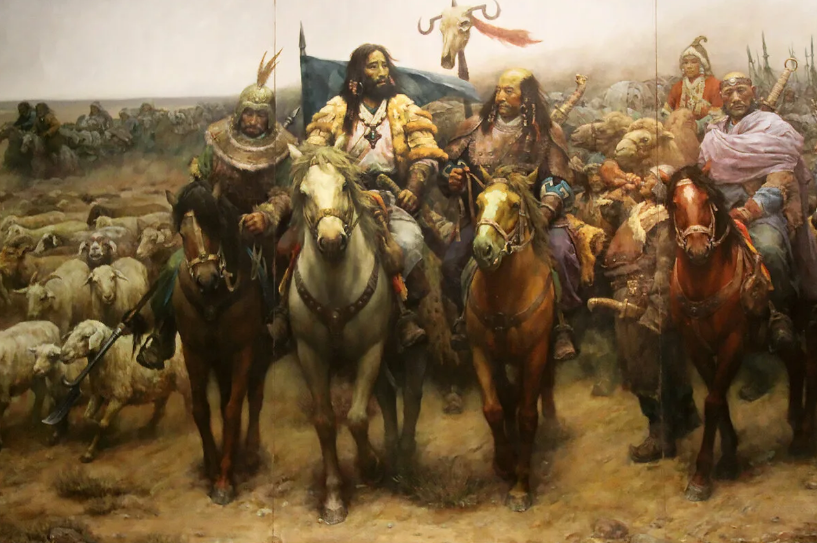
History knows many examples of great military cultures clashing, but one of the most intriguing confrontations has never fully taken place. We are talking about an attempted Mongol invasion of Japan in the 13th century, which was thwarted by a natural disaster – a typhoon known as «kamikaze» (divine wind). However, the question of who would prevail in the event of a successful landing of the Mongols and a full-scale clash with the samurai still causes heated debate among historians and fans of military history.
In this article, we will try to analyze a hypothetical scenario of such a conflict by examining the strengths and weaknesses of both military cultures, their resources, tactics, and strategy. Our goal is not only to determine the likely winner, but also to understand what factors could influence the outcome of this confrontation.
Historical context
By the time of the attempted invasion of Japan in 1274 and 1281, the Mongol Empire was at the peak of its power. Under the rule of the descendants of Genghis Khan was a vast territory stretching from the Pacific Ocean to Eastern Europe. The Mongols conquered China, Korea, Central Asia and many other lands, creating the largest continental empire in the history of mankind.
Japan at that time was a feudal state, where the real power belonged to the military class – the samurai. The country was ruled by the Kamakura Shogunate, which managed to unite the warring clans in the face of an external threat.
Historical data indicate that the number of Mongol troops during the second invasion in 1281 was about 140,000 people, including Chinese and Korean soldiers. The fleet consisted of more than 4,400 ships. At the same time, Japan could put up about 100 000 — 120 000 samurai and their vassals to protect their shores.
Military organization
The Mongols
The Mongolian army was one of the most effective military machines in history. It was characterized by strict hierarchy and discipline. The army was based on cavalry, divided into light and heavy. The Mongol army was organized according to the decimal system: tens, hundreds, thousands and tumens (10,000 soldiers).
Information indicates that the Mongolian tumen could travel up to 100 kilometers per day, which provided incredible mobility for the army. Each warrior had several horses, which made it possible to maintain a high pace of movement for a long time.
Samurai
The military organization of the samurai was based on the feudal system. Each samurai was a vassal of a certain daimyo (feudal lord), who, in turn, was subordinate to the shogun. Samurai were professional warriors who devoted their entire lives to improving their fighting skills.
Data show that in the 13th century, the number of samurai class was about 5-7% of the total population of Japan. This means that with a population of about 7-8 million people, Japan could mobilize up to 400 000 — 500 000 warriors, including samurai and their vassals.
Weapons and equipment
The Mongols
The Mongol warriors were armed with composite bows, which were considered to be among the most powerful in the world. The firing range reached 300-350 meters, and the effective range was about 200-250 meters. In addition, the Mongols used sabers, spears, and maces.
The Mongols’ protective equipment consisted of light armor made of leather and reinforced with metal plates. Such armor provided good protection while maintaining mobility. The Mongols also used large shields made of willow twigs, which were light and effective against arrows.
Samurai
Samurai were famous for their katana swords, which were considered one of the best blades in the world. However, the main weapons on the battlefield were longbows (yumi), spears (yari), and naginatas (a type of halberd). The katana was used primarily in close combat or duels.
Samurai armor (o-yoroi) was a complex construction of many metal plates connected by cords. They provided excellent protection, but were heavier than their Mongolian counterparts. By the 13th century, samurai also began to use lighter armor (do-maru), which provided better mobility.
Combat tactics
The Mongols
The Mongols were masters of maneuver warfare. Their main tactic was to use the mobility of the cavalry to exhaust the enemy. A typical technique involved firing at the enemy from a long range, feigning retreat to ambush the enemy, and then a crushing attack.
Historical sources indicate that the Mongols could maintain a firing rate of up to 6-10 arrows per minute, creating a dense barrage. This allowed them to inflict serious damage on the enemy even before the melee began.
The Mongols were also skilled in siege warfare, using advanced technology borrowed from the conquered peoples. They used catapults, trebuchets and other siege weapons to destroy enemy fortifications.
Samurai
Samurai tactics were based on the individual skill of warriors and their code of honor, bushido. Traditionally, the battle began with an exchange of arrows, followed by hand-to-hand combat. Samurai preferred individual duels where they could demonstrate their skills.
However, by the 13th century samurai tactics had evolved. Dense formations of archers and spearmen appeared, capable of resisting cavalry attacks. The samurai also mastered the art of fortification, creating powerful fortifications along the coast.
The data shows that Japanese archers could maintain a rate of fire of up to 8-12 arrows per minute, which was comparable to the Mongolian figures. However, the firing range of Japanese bows was shorter, about 200-250 meters.
Resources and economics
The Mongols
The Mongol Empire possessed vast resources of the conquered territories. They could mobilize troops and resources from China, Korea, and other conquered lands. This gave them a significant advantage in terms of supplies and replenishing losses.
Information indicates that the annual income of the Mongol Empire in the 13th century could reach the equivalent of 7-8 million kilograms of silver. This allowed them to finance large-scale military campaigns and maintain a huge army.
However, in the event of an invasion of Japan, the Mongols would have faced a supply problem across the sea. Their logistics were set up for land campaigns, and sea transportation presented a certain difficulty.
Samurai
Japan’s resources were limited by the archipelago’s territory. However, the country had a developed agriculture and handicraft industry. Japanese craftsmen were famous for their skill in making weapons and armor.
The economy of Japan in the 13th century was predominantly agrarian. The data indicate that the annual rice harvest could reach 600 000 — 700 000 tons. This provided a stable food base to support the army.
An important advantage of the samurai was that they fought on their own territory. This simplified supply issues and made it possible to effectively use knowledge of the area.
Advantages and disadvantages
The Mongols had a number of significant advantages. Their vast military experience gained in numerous campaigns across Eurasia gave them strategic and tactical superiority. The high mobility and maneuverability of the mounted troops allowed them to move quickly and strike in unexpected places. Their superiority in ranged combat, thanks to their powerful composite bows, gave them the ability to inflict significant damage on the enemy even before the melee began. An effective command and control system ensured clear coordination of actions on the battlefield. Finally, access to the empire’s vast resources allowed them to support long-term military campaigns.
However, the Mongols also had serious drawbacks in the context of the invasion of Japan. Difficulties with naval logistics and the supply of troops on the islands could significantly limit their capabilities. The unfamiliar terrain and climate of Japan required time to adapt. Lack of experience in amphibious operations could lead to tactical errors during landing and anchoring on the coast. In addition, dependence on horses, which were difficult to transport and forage on the islands, could limit their mobility in the long run.
Samurai, in turn, had a number of important advantages. Fighting in their native territory with a familiar landscape and climate gave them a tactical advantage. High morale and willingness to defend their land to the last could play a decisive role in a protracted conflict. The superior armor provided excellent protection in close combat. A well-developed system of coastal fortifications would have made it difficult for the Mongols to land and advance inland. Finally, a well-established supply system on its territory would make it possible to maintain long-term resistance.
However, samurai also had their weaknesses. Less experience in large-scale battles could lead to tactical mistakes when facing the Mongol army. Vulnerability to mobile cavalry tactics in open terrain could be exploited by the Mongols to deliver decisive blows. The shorter range of the bows compared to the Mongolian ones put the Japanese archers at a disadvantage in long-range combat. Finally, the island nation’s limited resources could become a problem in the event of a protracted war and blockade by the Mongols.
Possible conflict analysis
If the Mongols had successfully landed in Japan, the conflict would probably have developed in several stages. At the initial stage, the Mongols would have tried to use their advantage in mobility and long-range combat, seeking to defeat the Japanese forces in the open field.
The samurai, realizing their vulnerability to Mongol cavalry on the plains, probably would have avoided major battles in the open. Instead, they could use the tactics of harassing the enemy, relying on a system of fortifications and using difficult terrain.
The Mongols, faced with supply problems and unfamiliar territory, would have been forced to disperse their forces to control the captured areas and secure supply lines. This could give the samurai the opportunity to attack individual enemy units, using a numerical advantage in local clashes.
An important factor would be the ability of the Mongols to adapt their tactics to the conditions of the island war. Historical evidence shows that the Mongols were able to learn quickly and adopt enemy tactics. For example, during the conquest of Southern China, they successfully mastered river and coastal navigation.
Samurai, in turn, could use their advantage in close combat and defensive weapons. In wooded and mountainous areas, where the Mongol cavalry was less effective, the samurai could impose close combat on the enemy, where their mastery of the sword and spear gave them an advantage.
The key point would be the Mongols’ ability to gain a foothold on the coast and establish reliable supply bases. If they managed to do this, they could gradually move inland, using their experience in siege warfare to capture Japanese fortresses and castles.
However, the samurai had a significant advantage in their knowledge of the area and the support of the local population. They could have organized an effective guerrilla war, disrupting the Mongols’ supply lines and harassing them with constant attacks.
It is important to note that the Mongols would have faced a time problem. The longer the campaign lasted, the more difficult it would be to maintain supplies for the army across the sea, especially given the typhoon season.
The outcome of the conflict would largely depend on the Mongols’ ability to quickly achieve decisive victories and break the Japanese will to resist. If the war dragged on, the advantage would gradually shift to the samurai fighting in their native land.
Conclusion
An analysis of a possible conflict between the Mongols and the samurai shows that the outcome of such a confrontation would be far from unambiguous. The Mongols undoubtedly had significant advantages in terms of combat experience, mobility, and numerical superiority. Their combat tactics, honed in numerous campaigns, could prove effective even in the unusual conditions of island Japan.
However, the samurai, fighting in their native land, had their strengths. Their knowledge of the area, a well-developed system of fortifications and high morale could be decisive factors in a protracted conflict. In addition, difficulties with naval supplies and an unfamiliar climate could significantly weaken the advantages of the Mongolian army.
In the short term, the Mongols would probably have an advantage due to their mobility and tactical prowess. However, the longer the war lasted, the more likely the samurai would be to win. The final outcome would largely depend on the Mongols’ ability to quickly gain a foothold on the Japanese islands and adapt to the new conditions of warfare.
Thus, the answer to the question «Who is stronger: the Mongols or the samurai?» it cannot be unambiguous. Both sides had unique strengths and could have gained the upper hand in different circumstances. This hypothetical conflict remains one of the most intriguing «what ifs» in military history, continuing to inspire historians and amateurs to new discussions and analyses.