
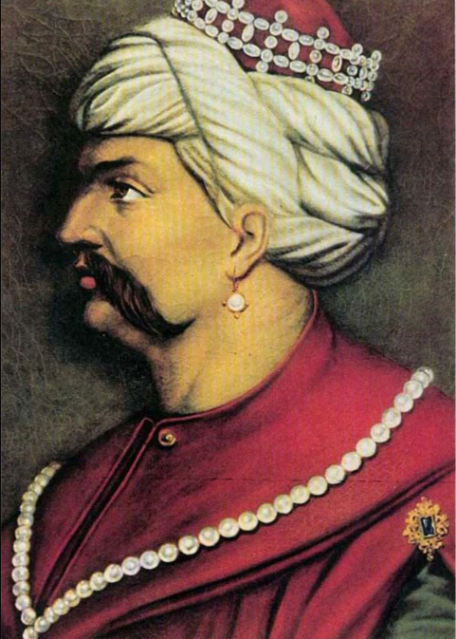
Of course, no one.
The simplest way to address the Padishah was «My Sultan.» Mothers addressed their powerful sons as «My Lion,» «My Prosperous,» «My beloved Lord,» etc. And there has been only one exception to this rule throughout history.
Mullah Gurani used to refer to Fatih Sultan Mehmed as «Mehmed». He was so proud that he never hesitated when meeting and greeting the Sultan. While it was traditionally customary to kiss the Sultan’s hands, Mullah Gurani himself held out his hand for a kiss.
Mehmed II was probably the sultan least suitable for such treatment, because it was he who, on his Eve, changed the role of the Padishah and made him an unattainable representative of absolute power. The first three sultans were «beys». Fatih Sultan Mehmed’s father signed his decrees as «Bey». After the conquest of Istanbul, Fatih ceased to be a «bey» and became a «Sultan», «Lord», «Great Ruler».
Before Fatih, the padishahs ruled the state together with viziers, veterans, who can be called representatives of the «founding families,» and government officials, with whom they constantly consulted. Who would become the padishah was decided by the viziers, noble families and governors of distant regions. These were such long-standing noble families of viziers as the Chandarls or representatives of Akinci/Anatolian beys like Michalloglu or Evrenesoglu. Fatih Sultan Mehmed got rid of them. He began by executing Chandarly’s vizier Khalil Pasha after coming to power. Mehmed completely switched to the Devshirme system, which had already begun to gain momentum during his father’s reign. These subjects were directly dependent on the sultan and had no roots. Thus, all constraints were eliminated. As the saying goes, «Rulers should not be bound by anything.»
Fatih even got rid of the devshirme viziers who supported him during the conquest of Istanbul and ascension to the throne. (The historian Pechevi wrote in the 16th century that «The Padishahs do not know loyalty,» because loyalty also binds. And the Sultan must be absolutely independent!). Thus, he showed that he does not intend to share his power with anyone. He gave the padishahs a place at the top of solitude. He changed all the rules of ceremonies and relationships according to this. For example, from now on, no one else could eat at the same table with the Padishah except for his family.
Mehmed was a stubborn, wayward and rebellious boy. (He retained these qualities during his reign, adding authoritarianism to them). And he did not improve in any way. As a child, he was sent as a governor to Manisa. Father Murad traditionally assigned him hodges (teachers), but how could Mehmed be forced to listen to them! He did not obey, did not study, and refused to take religious lessons and read the Koran. As a result, the famous Mullah Ahmed Gurani was sent to him. Gurani was in no way inferior to Shehzada in terms of character traits. He was just as willful and straightforward. Besides, he had a great scientific background. He taught and studied Fiqh (Islamic law), the Quran, and hadith in Baghdad, Hasankeyf, Damascus, Jerusalem, and Cairo. He returned to Anatolia after he spoke too harshly about Abu Hanifa, the founder of the Hanifa Catholic school, in one of the disputes, for which he was punished with 80 strokes of a stick. He started teaching in Bursa. He was tall and handsome with a long dyed beard. Energetic and authoritarian. Sultan Murad, sending him as a teacher to his son, handed him a stick and told him to use it if Mehmed was disobedient. There is a version that one day Mullah Gurani did use this stick and gave Mehmed a good beating. («Your father sent me to teach you. And if you don’t obey, so that I can guide you on the right path.» Mehmed Shehzade was beaten when he laughed in response to these words.)
When Mehmed ascended the throne for the second time in 1451, he offered his teacher Mullah Gurani the post of Grand Vizier, but he refused. Then he was appointed a Cossack. During the difficult period of the Istanbul campaign, he was one of those who encouraged Mehmed and thus ensured the continuation of the battle. The message about the capture of Istanbul in Arabic, sent to the Mamluk Sultan, which is considered a masterpiece of exquisite Arabic style, was also written by Mullah Gurani.
But then again, his intractability has always been a problem for both him and Mehmed, they were constantly arguing. During his service as a Cossack, Gurani, especially regarding new appointments, was guided solely by his own preferences, without taking into account either the opinion of the Sultan or the viziers. As a result, under the influence of the viziers, who could not tolerate him, he was appointed qadi in Bursa.
But even there he acted against the Sultan’s will. Rumor has it that he once beat up an envoy because, in Gurani’s opinion, the order he had given him from Mehmed was contrary to the law. He was also removed from this position. For a short period, he left the Empire and went to Cairo. He had a good reputation there. But Mehmed regretted that he had sent the teacher away, and called him back. Gurani returned in 1458 because, according to him, he saw his son in Mehmed, although he was persuaded to stay in Cairo. He was a cadet in Bursa for a while. In 1462 he became mufti in Istanbul, in 1480 he was appointed sheikhulislam and died in this post already under the rule of Bayezid II. He also never lowered his head in the presence of Fatih–Bayezid’s son.
On his deathbed, he told Davud Pasha, «Give my regards to Baezid. My last request to him is to come to my funeral and pay my debts from the state treasury.»
Gurani’s body, as he had bequeathed, was laid on straw and dragged along the ground. Bayezid II attended the funeral and paid off a debt of 180,000 silver akche from the state treasury. The whole of Istanbul was in mourning at his funeral.