
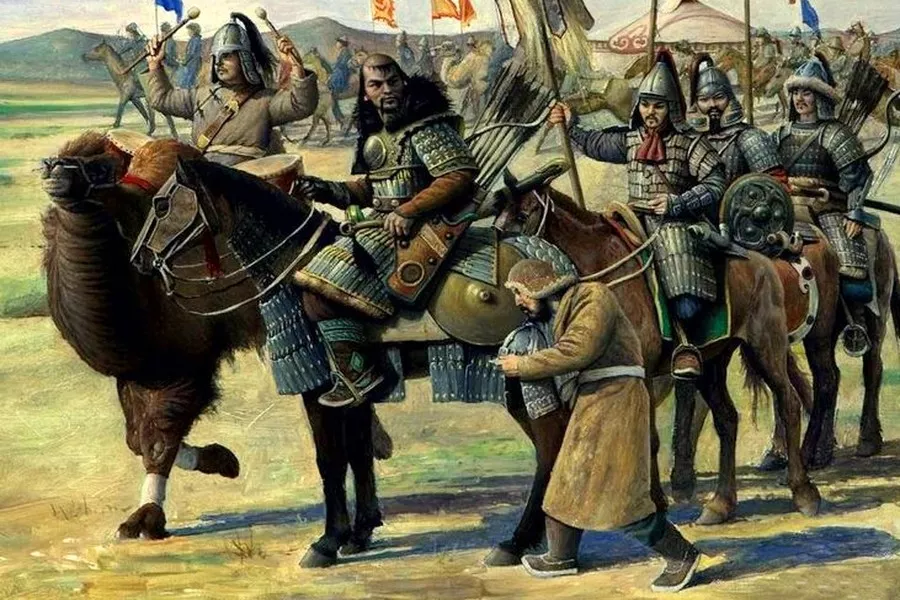
After the final conquest of Southern China by the Mongols in 1279, Mongol Khan Kublai faced a difficult task.: What should I do next?
He had a huge army that either had to be disbanded or continued to be fed, which put a heavy burden on the treasury.

Kublai Khan (mong. Kublai Khan; Chinese: September 23, 1215 — February 18, 1294) was a Mongol khan, the founder of the Mongolian Yuan state, which included China. Thanks to Marco Polo, he is known in the West as «Kublai Khan»; this name was also pronounced as «Kubilai» or «Kubla» (the latter became especially common after S. T. Coleridge’s poem «Kubla Khan»).
Therefore, Kublai decided to occupy the army with the fulfillment of a grandiose task — the conquest of Indochina. Kublai needed Indochina for maritime trade with Iran. In principle, the same task is now being repeated by the new Chinese leadership, which has wrapped its financial tentacles around the entire Southeast Asia — from Indonesia to Sri Lanka.
Kublai Khan launched a war against Vietnam. At first, he wanted to reach a peaceful agreement with Burma.
At that time, there was a Pagan state in Burma.

Pagan (or Bagan, Burm. ပုဂံ, kya-var. Pjaa Gjan) is the ancient capital of the kingdom of the same name on the territory of modern Myanmar. The city is located on a dry plateau along the eastern bank of the Irrawaddy River, 145 km southwest of Mandalay, near the town of Chaouk in Magway County. Currently, there is an archaeological zone with thousands of pagodas, temples, stupas, and monasteries on the site of the ancient city. This area is a major attraction for Myanmar’s nascent tourism industry.
The Mongolian ambassadors visited the Pagan ruler Narathihapati in his capital.
They immediately insulted the king by entering the king’s chambers in their leather shoes. It was an insult to the Pagans and they executed the ambassadors.
In the spring of 1277, the Mongols invaded Pagan. Marco Polo also participated in the campaign, and he left notes about this event.

Marco Polo (ital. Marco Polo; September 15, 1254, Venice — January 8, 1324, there) was a Venetian merchant and traveler who presented the story of his journey through Asia in the famous «Book about the Diversity of the World». Despite doubts about the authenticity of the facts presented in this book, expressed from the moment of its appearance to the present, it serves as a valuable source of knowledge on geography, ethnography, history of Armenia, Iran, China, Kazakhstan, Mongolia, India, Indonesia and other countries in the Middle Ages. This book had a significant impact on navigators, cartographers, and writers of the 14th and 16th centuries. In particular, she was on Christopher Columbus’ ship during his search for a route to India; according to researchers, Columbus made 70 marks on her.
The Mongols had only one tumen (corps) of Turks. The rest of the army was made up of southern Chinese from previously conquered Yunnan.
They were confronted by a large army with 2,000 elephants. And most importantly, the harsh humid climate, unusual for steppe dwellers and impenetrable jungles.
Turkic horsemen fought dismounted in battles against elephants, and their main tactic was archery.
But there were too many Pagans. And the Mongols had to retreat.
In 1283, they launched a new offensive.
Finally, the Pagans were completely defeated. And their ruler disappeared into the jungle. In 1285, he agreed to accept Mongol rule and pay tribute. But the court of the Pagan ruler killed their king in 1287 and the war began again.
In the same year, 1287, the Mongol-Chinese army again invaded Pagan and captured its capital of the same name. This time, their campaign was fair in the eyes of the population, as they were going to punish the regicides.
The capital was destroyed, and the state fell into chaos.
In March 1298, the new Pagan ruler, Chozwa, recognized the Mongol rule. But he was overthrown, too.
In 1300-1301, the Mongols again made campaigns in Pagan, but after plundering it, they abandoned it, as the country finally fell into anarchy and there was no way to rule it.
Then the Mongols turned their attention to the islands of modern Indonesia. In Sumatra, the Mongols were formally subordinated. But the Raja of the Javanese did not submit and, on the contrary, conquered Sumatra in revenge for submission.
In 1289, the Mongol ambassador was expelled from Java, putting a shameful stigma on his forehead.
The Mongols assembled a fleet and 20,000 troops with a year’s supply of provisions landed in Java in early 1293. At this time, the Rajah of Java had already been killed by the rebels. His son Vijaya began to ask for help from the Mongols. The Mongols helped him and defeated the rebels.
Vijaya then treacherously attacked the Mongols and defeated their vanguard. Then the Mongols surrounded them in the mountains and forced the Mongols to retreat.
The time of the monsoon was approaching, and the Mongols fell ill with tropical fever. The Mongols had to return without slurping salt.
And the treacherous Vijaya founded a new dynasty, which ruled the first centralized Indonesian state of Majapahit (1293-1520 years of existence).
Thus, Kublai Khan’s idea of a maritime Silk Road through Indochina ended unsuccessfully. Now we’ll have to see if modern China can do it.