
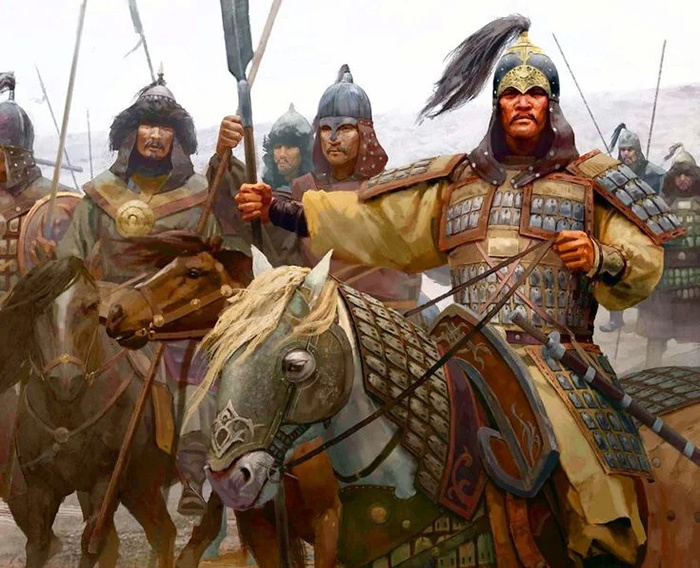
In 1252, the supreme power at the kurultai (congress of the highest Mongolian nobility) was completely seized by the sons of the deceased great Khan Tolui, who were the grandchildren of Genghis Khan himself. Tolui’s eldest son, Mongke, became the great khan, and his three brothers received significant territories under their control. Tolui’s third son, Kublai, was the least fortunate. China was allocated to him as a ulus, in most of the provinces of which rebellions constantly broke out, and the south was actually independent.
Here and further along the text are the most famous images of Kublai Khan, both medieval and more modern.
With his belligerence and ambition, Kublai was very similar to his grandfather, Genghis Khan, so he took up the task of restoring order with all seriousness and thoroughness. First of all, he conquered the Dali Kingdom (present-day Yunnan Province of China). Then Kublai, together with Mongke, conquered the Yangtze and Henan interfluve (modern Chinese provinces of Sichuan and Henan) with a joint double strike.
In 1258, the brothers led their troops West, capturing the vast plateau of the Tibetan Plateau (present-day Southwestern China) and the nomadic Uighurs (today the Xinjiang Uygur Autonomous Region in western China). The Great Khan intended to further conquer India and Burma, but suddenly died during an epidemic that engulfed the Mongol troops.
In June 1260, Kublai, bypassing the laws of Yasa, according to which the ruler of Mongolia was necessarily elected at the kurultai in the presence of all direct descendants of Genghis Khan, proclaimed himself the great Khan. In response, the Mongol nobility gathered in Karakorum and declared Kublai’s younger brother, Arig Bug, the great khan.
For four years there was civil strife, in which Kublai decisively won. True, by that time several western uluses had completely disappeared from the Mongol Empire – the Golden Horde, the Middle East and the Caucasus, but this did not really bother the great Khan. He intended to unite Central Asia, Indochina and the Far East under his rule, but he was not interested in other lands.
In 1264, after suppressing the last pockets of resistance in Central China, Kublai proclaimed himself emperor and moved his capital to present-day Beijing. Over the next seven years, Mongol troops steadily advanced towards the Pacific coast, capturing the last independent Chinese territories in the south and west. In 1266, Kublai Khan subjugated Korea.

In 1271, almost all of China submitted to the Great Khan. Now Kublai declared himself not only the Chinese emperor and the great khan of the Mongols, but also the founder of the new imperial Yuan dynasty («the beginning»), and chose Shi Tzu as his throne name. To further consolidate his power, Kublai decided to conquer Japan and the state of Southern Sun (present-day provinces of Guangxi and Guangdong).
The emperor decided to strike his first blow at the Japanese islands. Back in 1268, the first Mongol embassy arrived in Japan demanding vassalage. This was followed by several more similar ultimatums. Having received a categorical refusal, Kublai began carefully preparing a naval expedition to conquer Japan.
On November 3, 1274, 800 ships of various classes (mostly Korean and Chinese junks) sailed from the Korean port of Masan, carrying about 25,000 soldiers and 15,000 sailors on their decks. Initially, the invasion was successful. The Mongols captured the islands of Iki and Komoda (Tsushima). On November 19, the main forces of the Mongolian fleet reached Kyushu Island and entered Hakata Bay.
Liu Fok Hen– the main Mongolian commander, began the landing. The Japanese samurai, honoring the Bushido code, allowed the enemy not only to reach the shore, but also to line up in battle formations. As prescribed by ancient tradition, the samurai leaders officially challenged the Mongols and invited them to fight. The steppe nomads had never dealt with professional Japanese warriors before.
The Mongols had a hard time, but using their numerical advantage and cavalry, they gradually began to overpower the samurai. The coming night forced the parties to disperse and postpone the clarification of the winner. In the early morning of November 20, a severe storm broke out (according to other sources, a typhoon hit). Giant waves sank more than 200 Mongolian ships, and hundreds more were damaged. Liu Fok Hen’s fleet lost 13,500 soldiers and 7,000 sailors. After learning about the huge human losses and the destruction of the fourth part of the fleet, Kublai ordered his squadron to return.
An unsuccessful expedition to the Japanese shores only provoked the Mongol conqueror. In 1276, Kublai’s troops invaded Southern Sun, conquering this state and ravaging its capital Hangzhou. After this success, the emperor began to prepare for a rematch on the Japanese Islands. By his order, hundreds of warships and transport ships were built and confiscated from the subject peoples every year.
On May 22, 1281, the largest flotilla in the history of mankind left the ports of China and Korea, heading for the Japanese islands. About 3,500 ships (300 large Korean galleys, 1,170 Chinese junks) and small boats carrying 40,000 sailors and 100,000 warriors (40,000 Mongolian, 40,000 Chinese, 20,000 Korean) gathered under the banners of Kublai Khan. Hwang Buako was appointed Supreme Commander. This whole armada repeated the path of the previous campaign. Once again, the islands of Iki and Tsushima were the first to fall. On June 21, the vanguard of the Mongolian fleet appeared in the Kyushu raid.
This time, the Japanese were not as noble as last time. They concentrated two detachments of 10,000 samurai along Hakata Bay and threw their forces into battle alternately to prevent the enemy from gaining a foothold on the shore. For nine days, the Mongols tried to retake the bridgehead, but the narrowness of the bay and numerous shoals did not allow them to use an overwhelming numerical advantage.
Having lost dozens of ships and several thousand fighters, Hwang Buako was forced to retreat to Takashima Island. After waiting for the unification of all his available forces, Hwang Buako began to concentrate his ships on August 12 for a decisive attack on the coast of Kyushu. The Mongols intended to land in several places at once and throw back the Japanese barriers.
In the midst of preparations, on August 15, 1281, a powerful typhoon struck the Hwang Buako fleet. He scattered and sank the Mongol flotilla, sinking about 3,000 ships and 100,000 people. The surviving ships took refuge in Takashima for repairs, but there the Mongolian parking lot was suddenly attacked by the Samurai army of Seni Kagasuke. Taken by surprise, the Mongols, Koreans, and Chinese were completely defeated. Only three hundred ships with 3,000 soldiers returned to the ports of the Kublai Empire.
The most terrible and large-scale maritime disaster in the history of mankind saved Japan from the imminent Mongol invasion, devastation and conquest. Kublai Khan became one of the unluckiest rulers of the medieval East. The typhoon that destroyed the Mongolian fleet was called «kamikaze» («divine wind» or «wind of retribution») and for a long time was revered as «the sending down of the Goddess of the Sun.»
Another Japanese disaster marked the decline of Kublai’s military star. In 1284-85, he organized two large-scale campaigns against Vietnam. Mongolian and Chinese troops reached the shores of the Gulf of Tonkin, twice stormed the Vietnamese capital Hanoi, but each time the Vietnamese launched a guerrilla war and expelled the aliens.
The conquest of the northern part of Burma and its capital, Pandong, was a small consolation for the emperor. However, uprisings and rebellions constantly broke out in these occupied lands. In 1292-93 . Kublai organized his last campaign of conquest, this time against the state of Majapahit, located on the island of Java. About 20,000 warriors per 1,000 ships reached the Indonesian archipelago. The island of Java was captured by the Mongols. Kublai gave power to one of the influential local feudal lords. But he was not going to be a Mongol vassal and soon drove the newcomers back to China.
This latest setback undermined the 79-year-old emperor’s health. He died in 1294. Kublai Khan entered world history not only as a great conqueror. He also became famous as a wise politician. He promoted the spread of Buddhism by founding temples and distributing benefits to top Buddhist dignitaries and preachers. Kublai Khan also developed the Mongolian alphabet. He divided his state into 12 provinces, consolidating centralized power.
Under Kublai Khan, the Mongol empire, transformed by his efforts into the Yuan Empire, reached its last heyday and power. To his successors, Kublai left a vast country stretching from the Pamirs and Tibet to the Sea of Japan and from Lake Baikal to the South China Sea.

The territory of the Yuan Empire, created by the great Khan Kublai, at the time of his death

All images used in this publication are taken from open sources.