
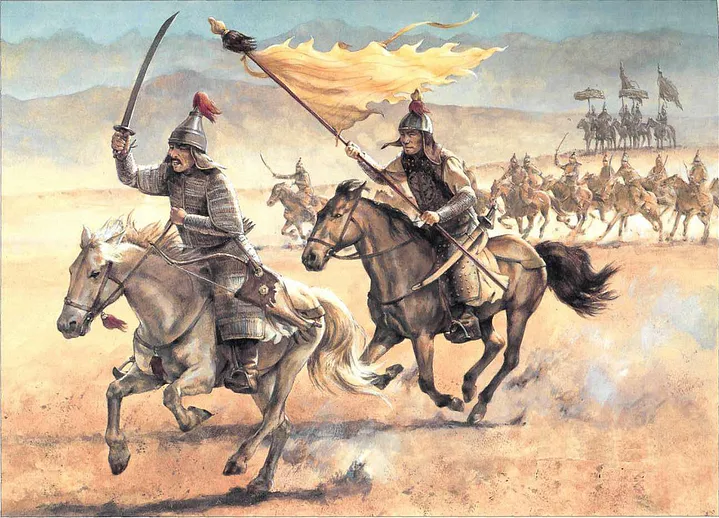
Today, only Russian Kalmyks, some residents of the western Mongolian aimags (regions), as well as very small groups of nomads from the Chinese region of Xinjiang can rightfully consider themselves descendants of the Oirats. But once it was a large and powerful people who exerted a significant influence on Asian politics and created a vast powder empire with a strong nomadic origin. Due to a series of unsuccessful wars and epidemics, many of them were wiped off the face of the earth, and the remnants later assimilated with the Mongols.

Let’s tell their story.
According to the most common version, the word «oirats» in Mongolian means «forest people». In the 13th century, a group of nomads under this name lived in the area of Tuva and the current northernmost Mongolian aimag of Khubsugul. It was a very ethnically diverse place. There were equally diverse tribes of Mongolian, Turkic, Samoyed, and Tunguska origin. By that time, they were so mixed up that it was impossible to draw a clear line. From this region came the commander Tsubodai, whose family had long been a vassal of the Borjigins, the family of Genghis Khan. It was here that the ancestors of the Buryats, Tuvans and Oirats were formed.
The forest peoples stood on the side of Jamukha, the twin brother and then enemy of the founder of the Mongol Empire. But after defeating him, these people were conquered by the Crown Prince of Jochi and intermarried with the ruling dynasty. Many of the Oirat warriors later participated in the Mongol campaigns, especially in the invasion of the Middle East. In 1256, a strong corps marched to the west and fought the assassins in Iran and Azerbaijan and the Abbasids in Iraq. The fall of the Hulaguid dynasty was due to the fact that Ali Pasha, the head of the Oirats who lived in this state, sent his enemy Ilkhan Arpa-keun to heaven. After that, the central government in the southwestern Mongolian state was destroyed.

Those Oirats who remained in their homeland took part in the Toluid civil war, when the brothers Arig-Bugha and Kublai shared the throne of the great Khan. The latter won, relying on China’s resources, after which the Oirats who fought on the opposite side joined his service. At this time, at the beginning of the 14th century, they actually moved to the west of Mongolia to resist the Chagatai Khanate, which was not always submissive. It was then that the union of the four main Oirat tribes – the Olets, Torguts, Derbets and Khoshuts — was formed. Later, other steppe clans joined them. Unlike the rest of the Mongols, they were ruled by their own Taishi princes, and only the Khoshut leaders were Genghisids.
The rise of the Oirats began in the middle of the 14th century, when Mongol rule in China and the Middle East was swept away. These people turned out to be the strongest and most organized at the moment and joined the struggle for dominion over the entire Mongolian world. The greatest ruler of that era was the head of this union, Esen-taishi, who ruled in 1439-1454.
He repeatedly smashed the remnants of the Chagatai Khanate in Central Asia, twice captured its ruler, fought with China and even captured its emperor. After that, the prince stopped hostilities, offering to conclude a peace that was beneficial to himself. But the officials of the Celestial Empire decided to resist without their master, and eventually he was released home without ransom. In 1453, Esen-taishi appeared at the kurultai, where the election of a new great khan took place. As a result, he received this title, and the head of the Mongol Empire was not Genghisid.
For the next centuries, the Oirats were shaken by strife, they often fought with the eastern Mongols and were pushed further west by them. But they carried out a successful campaign in the khanate of Abulkhair, the eastern fragment of the Golden Horde. As a result, the nomadic Uzbeks and Kazakhs finally separated from each other, and eventually two new peoples emerged.
For this reason, the Oirats occupied significant territories that were allied with each other, but pursued their own policies and had internal self-government. At that time, Muslim Turks increasingly began to call them Kalmyks, which means «separated» (from other Mongols).
Soon three separate states were created. After a successful raid on the Nogai Horde, Taisha Ho-Urluk, led by his subordinates, conquered the Lower Volga region for himself in the mid-1620s. In 1634, the Dzungarian Khanate emerged on the border of present-day China and Kazakhstan, which would later become a major empire of modern times and form a technologically advanced modern army. In 1642, the Khoshut Khanate was founded in Tibet, which later became part of Dzungaria.

A series of major wars awaited the Oirats, during which they would conquer a good half of Kazakhstan; they would conquer the remnants of the Chagatai Khanate, but allow the local Genghisids to rule, provided their authority was recognized; they would be close to conquering the whole of Mongolia, but they would face the Manchu Qing Empire in China. The two great powers had been fighting each other for a good hundred years, during which the Oirats had won more than once. But the resources of the Celestial Empire and the capabilities of their country were simply incommensurable, and therefore brute force eventually overcame their tenacity and military skill.