
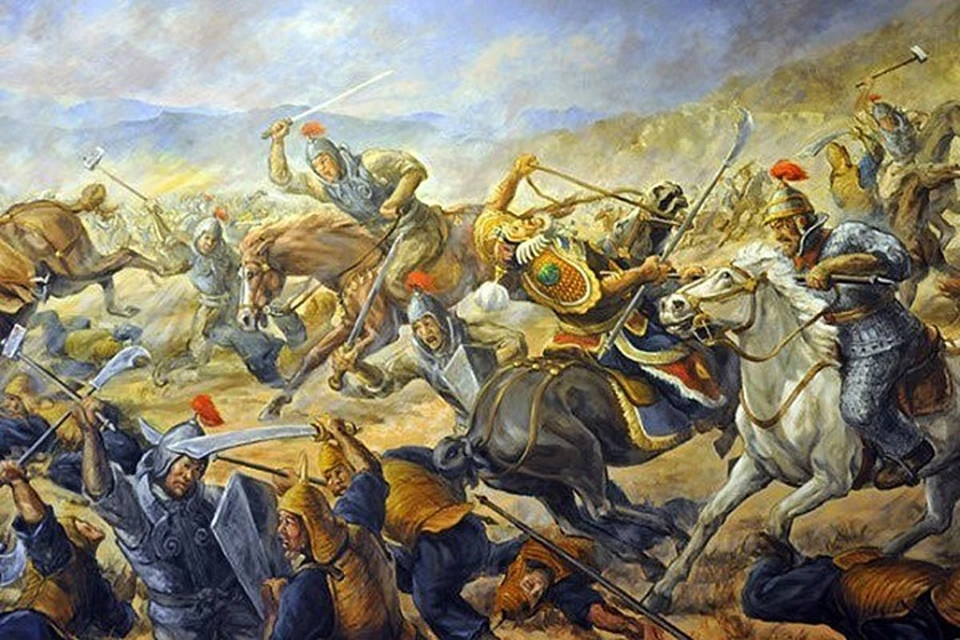
The Battle of Orbulak in 1643 was the first battle in the hundred-year Kazakh-Dzungarian war. Despite the fact that the Kazakhs won then, they suffered many defeats in the future and only with great difficulty stood up. Therefore, the battle is currently being evaluated not as a test of strength, but as a crucial historical event. It is most similar to the feat of three hundred Spartans at Thermopylae, except that a small detachment of Kazakh batyrs, with the support of the allies, managed to defeat a powerful enemy.

Let’s tell you how it was.
During the 15th and 16th centuries, the western Mongol Oirats gradually freed themselves from the power of the Genghisids and began to be ruled by their own princes. Their Turkic neighbors called them «Kalmyks,» which means «separated.»
They often waged internecine wars, but in 1640 they held a general congress, where they adopted a universal law — the Steppe Code and confirmed the creation of a new nomadic state – the Dzungarian Khanate. There, it was decided to attack the Kirghiz, Kazakhs and the Bukhara Khanate in order to capture trophies and obtain new pastures. The army was assembled three years later and was led by Erdeni-Batur, a historical figure who had the same importance for his people as Peter I had for Russia.
If the Oirats achieved unity at that time, then the Kazakh state was on the verge of disintegration. When the talented commander and politician Yessim Khan passed away, many feudal lords left their subordination and stopped obeying his son Zhangir, although he was also quite good as a sovereign.
The main area of attack was the territory of modern Southern Kazakhstan, after the conquest of which the Oirats planned to invade the possessions of Bukhara. Along the way, Kyrgyz nomads were plundered, and the few survivors fled to their ally, the Kazakh Khan Zhangir.
Thus, he perfectly understood the enemy’s route and decided to prepare ahead of time. Messengers were sent to the neighbors, and the Bukhara military commander, governor of Samarkand Zhalantos-batyr — Kazakh by nationality, came to the rescue with a 20,000–strong army.
It was decided to set up an ambush in the narrow gorge of the Orbulak River, where the Kazakhs built extensive tree-and-earth fortifications. They themselves settled down there with guns, and a mounted Kyrgyz contingent was stationed behind the hill. For the first time in their history, the nomads relied not on sabers and bows, but on guns purchased in Persia.
Zhangir Khan had 600 of his own soldiers and 2,000 Kyrgyz at his disposal. They had to meet the enemy’s army, which, according to various estimates, could amount to 20-50 thousand people. At that time, no one knew or could have known whether the Bukhara reinforcements would arrive in time.

Considering that the width of the valley was about 2.5 kilometers, a sudden strike guaranteed the breakthrough of the fortifications and the subsequent victory. Erdeni-Batur tried to bite his enemy, but due to the inability to maneuver and withdraw, he only suffered unnecessary losses. At the hottest moment of the battle, the Kyrgyz and Zhangir Khan’s personal detachment fell on the Kalmyks out of the blue.
Only then did the advancing army withdraw in order to regroup. Due to the huge numerical advantage, she still had the opportunity to rally the ranks and deliver a decisive blow. However, at that very moment, the horsemen of Zhalantos batyr appeared in the rear. The Oirats didn’t know how many people he had brought, but it was obvious that there were a lot of them. In the end, they had to retreat without glory.
On the way back, the Kyrgyz were once again looted in order not to return completely without loot. When Erdeni-Batur arrived at his headquarters, he was met there by the Russian envoys Kucheev and Ilyin. They learned the details of the defeat from the Kyrgyz prisoners, since the Oirats themselves did not want to talk about their failure.

Unfortunately, they did not find out whether there was a specific location or the exact number of parties, so they indicated everything very roughly in their report. It was only clear that the battle had taken place somewhere on the border of the Bukhara, Kyrgyz and Kazakh lands, and that there were many more attackers.
In general, the Kazakhs were then able to hold Semirechye and were able to prepare for new invasions. But even despite the external danger, they were far from united, and therefore a long-term war began.