
The history of the Kalmyks is inextricably linked with the past of Russia, it allows us to better understand this people, to feel their values and ideals. More than three and a half centuries ago, the Kalmyks voluntarily became subjects of Russia, thereby tying their destinies with the Russians. However, these times were preceded by difficult ordeals and dramatic events that took place in the life of the tribes.
Many scientific papers have been written about the origin and formation of the Kalmyks as a people, but controversial issues remain to this day. I suggest diving into Kalmykia’s past and learning about the fate of its people. Who became the ancestors of modern Kalmyks? What awaited them after joining Russia?
Name of the people
The Kalmyks themselves call themselves “halmgud». According to linguists, this word belongs to the Turkic languages, and its base “hal-” (“gal-”) means “separation». Regarding this interpretation of the self-designation and the familiar word “Kalmyk”, the Russian scientist V.M.Bakunin said that he had lived in Kalmyki for many years. He wrote:
«This word «Kalmyk» comes from the Tatar language, because the Tatars call them «kalmak», which means «backward» or «backward».
This definition vividly reflects the history of the Kalmyk people. In the works of the German researcher Peter Pallas, it is noted that the Kalmyks can indeed be called a separate tribe from the main group of their ancestors, the Oirat Mongols.
His colleague B. Bergman disagrees with this theory. In his opinion, the Kalmyks were called “apostates” because of their rejection of shamanism, which was the dominant religion of their ancestors. In my opinion, the first hypothesis is more correct, since the historical facts themselves speak in its favor.
The emergence of the Kalmyks
The Kalmyks were formed at the end of the 16th century. At that time, some of the Oirat tribes that had previously inhabited Dzungaria were separating from the majority. The movement of communities takes place in the Siberian borders — along the rivers Irtysh, Om, Ishim. Over time, the nomads moved to the southwestern lands, occupying territories near the Volga and the Caspian Sea. It is there, according to most historians, that the Kalmyks originated.
But what made some of the tribes go to new unknown lands? There are different opinions on this. The Oirats occupied considerable territories, and therefore, over time, they began to need new pastures and places of residence. This was probably the main reason for the group’s separation, which later gave rise to the Kalmyk people.
Internecine wars also played a significant role in displacing a significant part of the communities. However, the ancestors of the Kalmyks had to fight on their way to their new homeland. During the resettlement process, there were clashes with Nogais, Kazakhs, and Bashkirs.
Relations with Russians
Having established themselves in their new lands, the Kalmyks begin to establish relations with the Russians. I would like to point out that such an alliance had its benefits for each of the nations. The Kalmyks needed to expand their trade routes and develop economically.
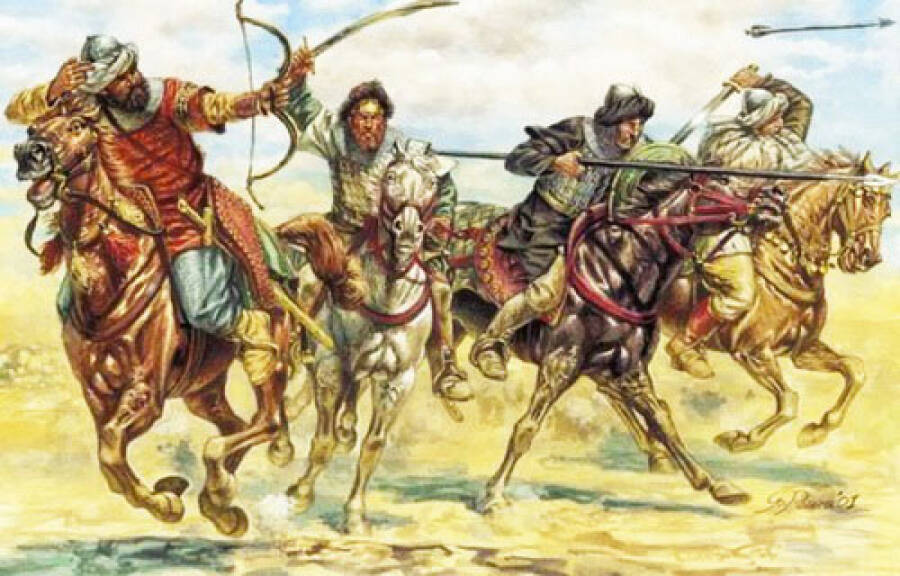
In turn, the Russians needed forces to resist the Tatars and Turks. The Kalmyks were an ideal option — they had thousands of troops and excellent cavalry. Representatives of this people participated in many military operations under the command of the Russians.
In the second half of the 16th century, the Kalmyk Khanate appeared on the territory of the Russian Empire, the inhabitants of which were subjects of the Russian tsar. However, the promises of the Kalmyk Taijas were not always fulfilled — the concept of the oath of allegiance between them and Russians was very different.
Researcher Fyodor Buhler noted in his works:
“The oath of allegiance of the nomadic Asian tribes in their eyes does not contain anything sacred. It is an easy means for them to achieve their intended benefits, and to violate it at the first opportunity means nothing to them.”

Kalmyks in traditional clothes. 1862
The new “separation” of the Kalmyks
Between representatives of the Russian and Kalmyk aristocracy, marriages were concluded, forming strong alliances between communities of different peoples. Christianization has become a negative aspect.
Many Kalmyks refused to accept the new faith, which is why some of the tribes returned to Dzungaria. The situation was aggravated by several famine winters, which made Kalmyk peasants unable to pay taxes to Russian landlords. The population was forced to flee from the unbearable rent.
The main part of the Kalmyks went to Manchuria. The difficult, grueling transition lasted more than six months. Some of the tribes suffered due to diseases, and a considerable number of Kalmyks were destroyed by the Kazakhs who attacked the fugitives.
The representatives of the people who remained in Russia became residents of the Astrakhan province. Like their ancestors, the Kalmyks have repeatedly performed well in many wars, which they went to with the Russians.

Vasily Vereshchagin «The Kalmyk Lama» 1869-1870
Kalmyks in our time
The last century brought many changes to the life of the Kalmyks. First of all, they became a settled people. The Russian authorities tried to raise the level of educated people in Kalmykia. People studied Latin and Cyrillic, with which Kalmyks could learn their native language. Later, it was decided to switch to Russian everywhere.
The Republic of Kalmykia is today a subject of the Russian Federation. Nowadays, about 165 thousand Kalmyks live on its territory, some of the people live in Kyrgyzstan and Kazakhstan. With the transition to a sedentary lifestyle, agriculture began to develop among the Kalmyks.
Today, cereals, flax, tobacco, watermelons and melons are grown in their homeland. People living near rivers are engaged in fishing, but even today cattle breeding plays a major role in the activities of the Kalmyk people. Like their ancestors, modern Kalmyks maintain trade relations with many neighboring peoples.
Modern Kalmyks are in awe of ancient customs and beliefs. Among the Kalmyks there are adherents of Christianity, Tibetan Buddhism, and Islam. At different periods of their history, they were influenced by other tribes, but the Kalmyks retained their national identity, and today Kalmykia is experiencing a cultural revival of its former traditions.