
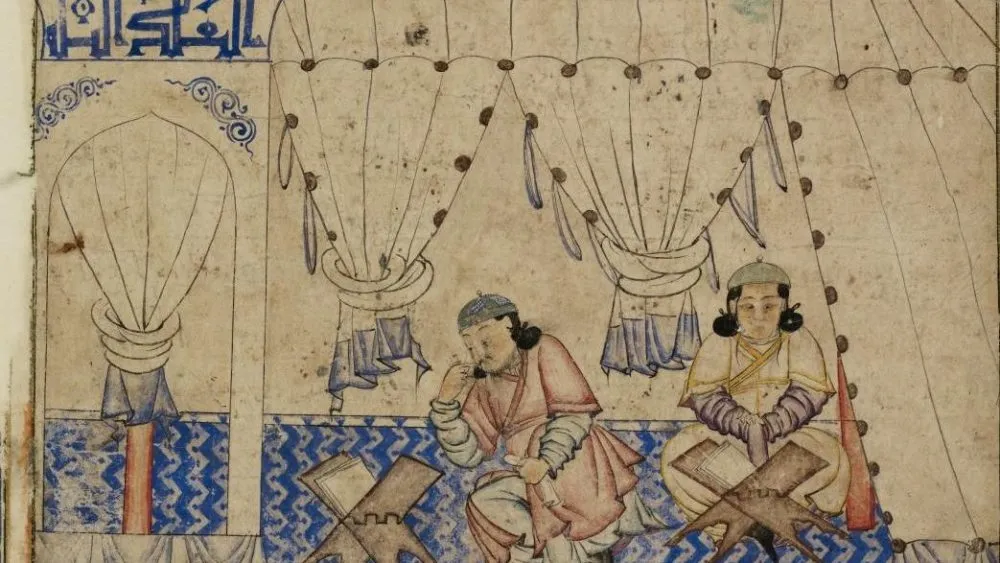
From the very beginning, the Volga basin was the center of life of the rulers of the Golden Horde; moreover, the city of Bulgarians, the former capital of Volga Bulgaria (its remains are in Tatarstan), was the first city in which the Jochids minted their coin. Under the Mongols, other cities arose in the Volga basin. Ukek arose (on the right bank of the Volga River near modern Saratov), then the Jochids were built on the left bank of the Akhtuba (Astrakhan region). its capital, called Sarai («Palace»; Persian), and on the right bank of the Yaika River — the town of Saraychik («Small Sarai»), etc. Cities were not only the center of crafts and trade, but also important administrative and cultural centers of the country.
True, every major city, from Urgench on the Amur River, Sarai in the Volga region to Solkhat (now Stary Krym), had its own life and cultural traditions, reflected in the type of coins, on artistic products, on architecture, etc. Nevertheless, we can talk about the general culture of the Golden Horde Khanate — Muslim. The adoption of Islam by the Jochid dynasty, as already noted, did not create a national ideology, but the culture of the Golden Horde state has taken on a certain Muslim imprint since the reign of Uzbek Khan (1313-1341). «Due to the Khans’ orientation towards Islam and the urban lifestyle of the Central Asian-Iranian type,» writes Professor G. A. Fedorov—Davydov, the largest expert on the history and culture of the Golden Horde, «in the South Russian steppe, far from Islam, a vibrant urban oriental medieval culture, completely alien to the nomads, the culture of irrigation bowls and mosaic panels on the mosques, Arab stargazers, Persian verses and Muslim spiritual scholarship, interpreters of the Koran and mathematical algebraists, exquisitely delicate ornaments and calligraphy» [Fedorov-Davydov, 1976, p. 118].
In the life of the Golden Horde state, two languages were spoken: Mongolian, Turkic, and two alphabets: Uighur and Arabic. The relationship between these two languages and alphabets was different in different periods of the history of the state of the descendants of Jochi.
The Mongol nomads who came to Desht-i Kipchak were significantly outnumbered by the local Turks, and the descendants of the Mongol conquerors soon lost their language and adopted the Turkic language of the Kipchaks. In this sense, it is remarkable that the Arab traveler Ibn Battuta, who visited the headquarters of the Mongol emir Tughluk Timur and the horde of the Golden Horde Khan Uzbek in 1333-1334, heard only Turkic words here and there; during the feast, a sermon delivered in Arabic was translated into Turkic.
However, in the first half of the 14th century, the Mongolian language had not yet completely fallen out of use among the Genghisids and the Mongol nomadic nobility of Desht-i Kipchak. The Uzbek Khan example is interesting in this regard. In the winter of 718/1318-1319, during Uzbek Khan’s campaign in Arran (the region from Derbent to the Kura River), according to the story of historian Wassaf, a contemporary of Golden Horde Khan, the Desht captured two Mongols from the army of Hulaguid Abu Said, the Mongol ruler of Iran, and brought them to Uzbek Khan, who personally began to interrogate them about the position of the commander Ilkhans of the Emir of Chupan. They replied: «A Chupan with 10 mists of troops, to set up an ambush, entered your rear through Karchaga.» Uzbek Khan told Kutluk Timur and Isa-Gurgan in Mongolian: «The man we are looking for is in our rear; where should we go?» It is remarkable that Hulaguid Abu Said (ruled in Iran in 1317-1335), according to the author of Tarikh-i Sheikh Uwais Abu Bakr al-Qutbi al-Ahari, «knew Mongolian and Persian well He wrote a letter and wrote it well» [Tarikh-i Sheikh Uweis, p. 102].
During the time of Genghis Khan (died 1227), the Uighur alphabet was adopted and widely used in Mongolia. By order of Genghis Khan, the entire younger generation of the Mongolian nobility, including the sons of the emperor himself, studied Uighur writing. The same letter served to record the «Great Yasa» (collection of laws and orders of Genghis Khan) and to compile the «Altan-daftar» — the «Golden Scroll» (the official history of the khan’s Genghis family). Together with the Mongols, the Uighur script came to the west, to the country of the Kipchaks, where it had not been known before.
However, only a few written monuments written in Uighur script in the Mongolian language have been found on the territory of Juchiev Ulus so far: these are four paizi (paizi is a gold, silver, bronze or wooden plate with a certain inscription issued on behalf of the Mongolian Khan as a mandate), dating back to the XIII–XIV centuries. (for the paijs of the Jochids Tokhta (1290-1312), Uzbek (1313-1341), Keldibek (1361) and Abdallah (1362-1369), see [Kramarovsky, 2001, pp. 75-76]), and fragments of a manuscript on birch bark containing texts in Uighur script in two languages — Mongolian and Turkic. There are Golden Horde coins where the khan’s name is written in Uighur letters; however, there are no coins with Mongolian inscriptions in the Golden Horde, as far as is known; while there are coins with Turkic inscriptions in Arabic letters kutlug bolsun. There are Golden Horde documents, including Khan’s labels written in Uighur script in the Turkic language. There is a well-known version of «Muhabbat-nameh», a Turkic-language poem by the Golden Horde poet of the middle of the 14th century. Khorezmi, written in Uighur script.
Nevertheless, Arabic writing was in great use in the Golden Horde. From the very beginning, Golden Horde coins were minted with Arabic letters and Arabic inscriptions. A large number of documents (chartered labels, letters of the khans, etc.), as well as a number of works of art that came out of the Golden Horde and have survived to the present day, are written in the Turkic language in Arabic script. Among the latter, in particular:
1) Qutb’s poem «Khusrau and Shirin», the largest monument of Turkic-speaking Golden Horde literature, composed in 1340-1342 and dedicated to Tynybek, the eldest son of Khan Uzbek;
2) «Muhabbat-nameh» by the Golden Horde poet, nicknamed Khorezmi («Khorezmian»), the second of whose two lists is written in Arabic script; this poetic composition was composed in the Turkic language in 1353 on the banks of the Syr Darya;
3) at the end of the 14th century, the Golden Horde poet Saifi Sarai translated «Gulistan» by the famous Persian poet of the 13th century into Turkic. Saadi.
It is known that the Golden Horde poets of the 14th century had a literary predecessor. Thus, in the city of Barchkend (on the lower reaches of the Syr Darya), which was part of the Jochid possessions, in the second half of the 13th century lived the scientist Husam al-Din Asimi, who wrote works in three literary languages of the Muslim world — Arabic, Persian, and Turkic. According to another Turkestan scientist, Jamal Karshi (born in 628/1230-1231 in the city of Almalyk, basin of the Or), who met Husam al-Din Asimi in Barchkend in 672/1273-1274. His Arabic works were distinguished by eloquence, Persian by wit, Turkic by truthfulness and simplicity of style.
It is remarkable that the works of the Golden Horde writers of the 14th century were written in a language close to the literary Turkic language, which later, in the Timurid era, was called Chagatai. The formation of Central Asian literary Turki in the 15th century, i.e. the so-called Chagatai language, which for the first time openly entered into competition with Persian, is closely connected with an intense intellectual life and a powerful literary movement in the 14th century in the Golden Horde, especially in the Volga region, as well as in Khorezm and in neighboring areas along the lower and middle reaches of the Syr-Daria [Barthold, vol. 5, p. 121].
In short, the entire history of the state of the descendants of Jochi, which has been established so far, primarily by the work of Russian researchers, indicates that the Golden Horde was a cultural state; and it is a pity that the culture of the Golden Horde has still been poorly studied. However, it is encouraging to note that the growing interest in the history of the Juchi Ulus in Russian Oriental studies, especially in Tatarstan and Bashkiria, is arousing increasing attention to the problems of the material and spiritual culture of the Golden Horde (see [Turkological Collection 2001; Dasht-i Kipchak and the Golden Horde, 2003]).