
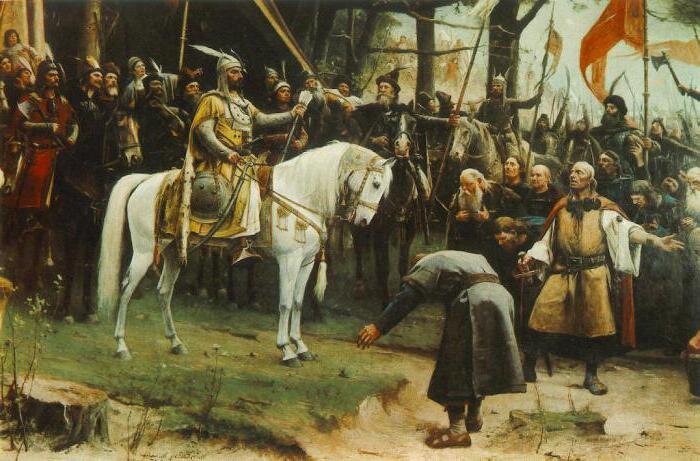
Shanyu Mode
Mode was the eldest son of the lifelong leader Shanyu Tumeng. His personality is shrouded in legend and would be practically mythical if it weren’t for the real victories over the Donghu and Yuezhi recorded by the Chinese.
It is no coincidence that some historians associate Mode with the mythical Oguz Khan. The question is not whether these figures existed, but where they came from. The identification of Mode and Oguz Khan (including in the folk memory of all steppe peoples) shows that Mode may have come from that part of the Xiongnu who migrated to the Sayan Mountains and mixed with the Proto-Turks there. The mixture of Turks and Xiongnu came to be called the Oguz. Interestingly, the exact number of Xiongnu clans is known to be 24. The Oguz had the same number.
It seems that this was no coincidence! At the same time, it should be remembered that Chinese chronicles noted that part of the Xiongnu migrated on carts drawn by oxen. And an ox in Turkic is Ogiz (a bull is Buka). The mythological image of Kok Ogiz holding the earth on his horns is widespread in Central Asia.
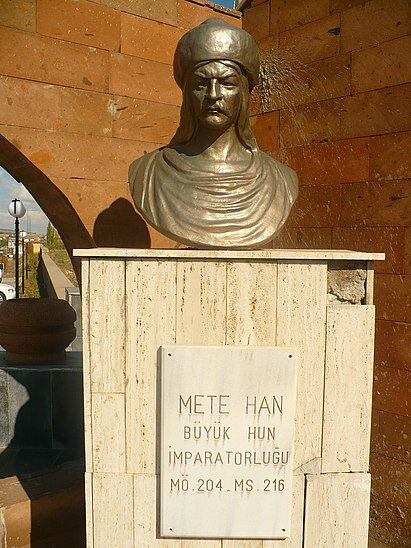
Mode, Maodun, Modun, in Turkic traditions Mete Khan (234-174 BC) — founder of the Xiongnu Empire and its ruler (shanyu) from 209 to 174 BC.
Thus, the Oguz substratum (a mixture of European Proto-Turks and Mongoloid Xiongnu with a significant admixture of Chinese blood) was able to oust the old tribal aristocracy of the Xiongnu in the person of Tumeng. These aristocrats did not want to fight anyone, and being peaceful people, they agreed to pay tribute to Donghu and send amanats (hostages) to the Yuezhi.
A new form of military organization, which Mode had observed among the Scythian Yuezhi, helped him defeat the elders (in terms of civilization). Instead of a tribal militia, Mode formed units of archers who avoided hand-to-hand combat and showered the enemy with a cloud of arrows. The fact that Mode adopted the Scythian model is confirmed by the practice of using “whistling” arrows (commander’s arrows, which gave target designation and orders to open fire), characteristic of the Saka (Scythians).
After seizing power, Mode led his horde to Donghu, defeated them, and expelled them from Manchuria (some of them, while others remained vassals). Thus, the Xiongnu loomed over the entire northern border of China.
Then came the period of the Yuezhi, with whom the Xiongnu had a long period of confrontation, associated with the same tactics of warfare that gave no one an advantage. It is not known whether the Xiongnu were able to completely defeat the Yuezhi, but Ordos, which was a transshipment base for Chinese foreign trade with Iran, came under their control. This significantly strengthened the Huns’ material base.
After the fall of the Qin dynasty, civil war broke out in China, and the Huns began to raid the border areas of China. They enjoyed this greatly, as it brought them extra income without the need to graze their cattle.
The Xiongnu against the Han
By 202 BC, the Han dynasty had come to power in China, and Shanyu Modu had solved the last foreign policy problem by conquering the Dingling and Kyrgyz (Gegun). The two empires were faced with a choice: peace or war.
Mode was the first to decide on war, and his four tumens (divided by the color of their horses—black, white, gray, and red) invaded Shanxi. Since Mode had made prior arrangements with the Chinese commander Han Xin, the nomads reached Shanxi Province unhindered, where they surrounded the Chinese army and Emperor Gaozu himself.
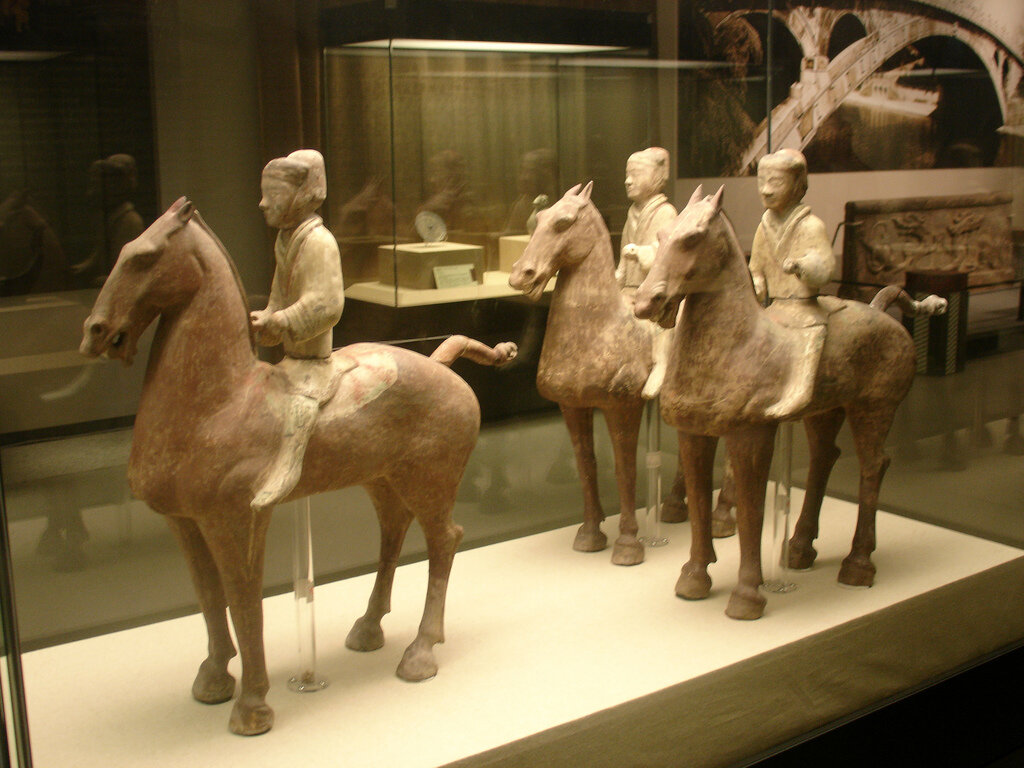
Painted ceramic statues of Chinese cavalrymen from the Han dynasty
Since the Chinese still outnumbered them, Mode, fearing that they would break through, agreed in 198 to an honorary treaty of “Peace and Kinship,” receiving a Chinese princess as his wife and consent to pay tribute in silk.
In essence, this meant that the Xiongnu became the masters of the northern provinces of China, where the local administration was already openly disobeying the central government.
The Xiongnu gradually penetrated deeper into Chinese territory, becoming suzerains to local rulers. The Han dynasty could do nothing about this, as it did not have sufficient forces to resist. But the Xiongnu could not completely conquer China either, as they kept their main forces against the Yuezhi, with whom they were engaged in a maneuverable steppe war that took a lot of strength and time. It was not until 177 BC that the Yuezhi were finally defeated and expelled from the territory of modern East Turkestan.
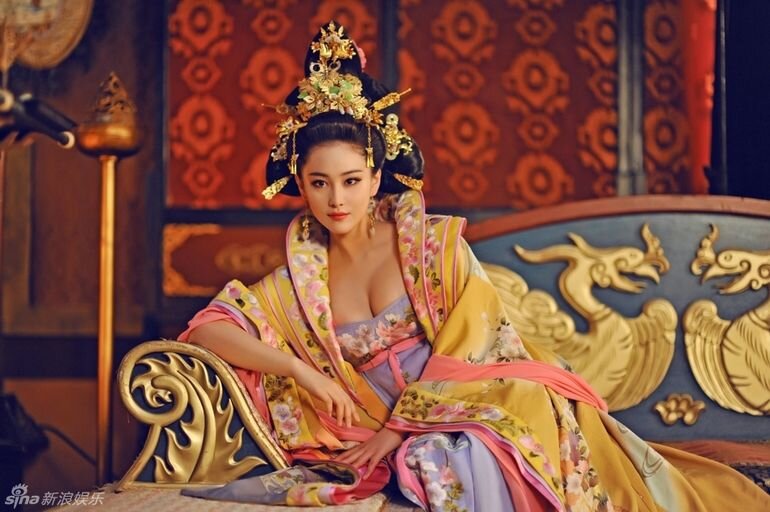
During this time (Emperor Gaozu died in 195), the cruel and cunning regent Lü Hou (Emperor Gaozu’s wife) was able to restore order in the country by physically destroying all rebellious commanders and aristocrats. This extraordinary woman was able to restore order in the country by increasing taxes, but at the same time executing every corrupt official (Stalin in a skirt). Taxes were heavy, but nothing more was taken beyond that, which allowed the peasants to breathe more freely and strengthened the economy.
In essence, it is Liu Hou who can be considered the true founder of the Han dynasty.
The Xiongnu and the Wusun
After the Chinese defeated the Rouran, they retreated to Donghu and the foothills of Tibet. Here, the Chinese encountered new peoples who lived quietly and peacefully under the protection of the warlike Rouran-Qian-Tibetans and the Asi-Wusun. The Tibetans were Mongoloids, and the Wusun were Indo-Europeans. Both peoples were nomadic, but they were also familiar with agriculture, which distinguished them favorably from the robbers of the Rouran and the perpetually nomadic Xiongnu.
The Wusun were red-haired and fair-haired strongmen with blue eyes. They were skilled with the bow (as is typical of the inhabitants of the foothills) and were good horsemen. The Wusun suffered at the hands of their relatives, the Yuezhi, who took away their best pastures and pushed them further and further east.
Therefore, Shanyu Mode easily found common ground with the Wusun, who most likely helped the Xiongnu defeat the Yuezhi. For this, the Wusun received the former lands of the Yuezhi (who called themselves the Tocharians) and protected the western borders of the Xiongnu nomads.
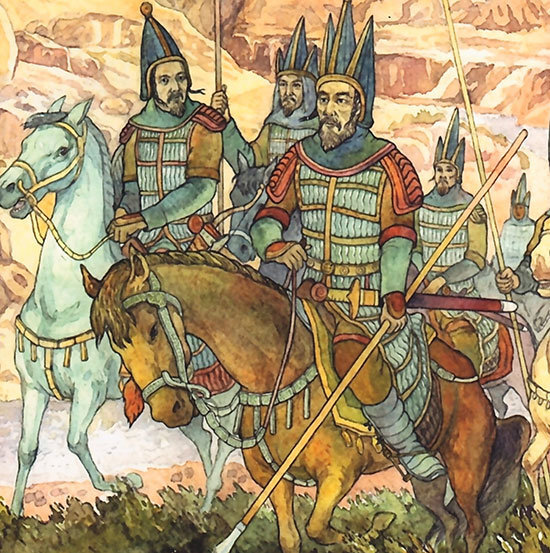
Wusun
Xiongnu society
Xiongnu society was complexly organized and included various ethnic groups, united in a traditional clan system.
Each clan could field between 2,000 and 10,000 warriors, which determined its strength and, therefore, how much it could expect to receive when the spoils were divided.
Above all the clans were three aristocratic clans: two Xiongnu clans, the Huayan (Hares) and the Xubu (Border), and one of the descendants of Chinese migrants, the Lan (Orchids). The entire state apparatus, from judges to military commanders, was recruited from these clans. The Shanyu clan was called Si Luan-di, and members of this clan could only marry members of the three aforementioned noble clans.
The organization of the Xiongnu state was based on non-interference in clan affairs. The clan aristocracy itself monitored the internal life of the clan and resolved all disputes (even murder). At the same time, relations between clans were monitored by the Shanyu’s apparatus. Here, everything was very strict — members of different clans were not allowed to conflict with each other, everything had to be decided by the Shanyu’s court. If anyone dared to draw a weapon in public during a dispute, it was punishable by death. Theft from other clans was punished by confiscation of the thief’s property and the sale of his entire family into slavery.
Such discipline, combined with clan democracy, allowed the Xiongnu society to unite without infringing on clan traditions or violating the principle of state unity. That is why, in terms of organization, the Xiongnu were far superior to their neighbors, the Donghu, the Qian, the Yuezhi, and even, at a certain stage (at the beginning of the Han dynasty), the Chinese.