
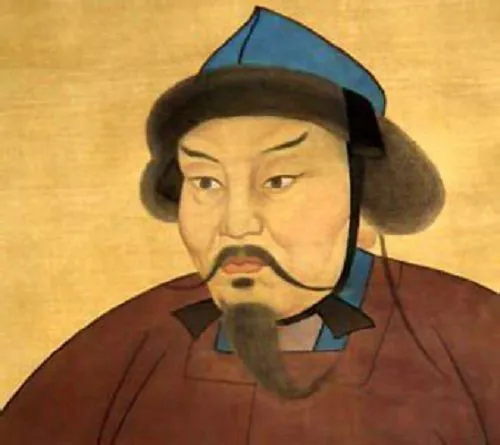
At one point, a staggering statistic was circulating online: one in every 200 men on Earth is a direct descendant of Genghis Khan. Sources claimed that today, his blood flows through the veins of 16 million people across Asia. It was said that this was the most widespread genetic legacy in human history—a veritable genetic storm that the Great Khan unleashed in a single century.
But is that really the case? And most importantly, which modern people can rightfully call themselves his blood heirs?
In the Footsteps of the “Star Cluster”
The sensation emerged in 2003. A group of geneticists discovered a unique Y-chromosomal haplogroup, C3, in 8% of men living in the territory of the former Mongol Empire. They named it the “star cluster.” The lineage was about a thousand years old, and its center of origin coincided with the territory of modern Mongolia. The conclusion was obvious: before us lay the legacy of Genghis Khan, who, as is well known, was not averse to leaving offspring (according to legend, his harem may have included up to several thousand women).
So who made the shortlist of the main heirs?
The Kazakhs and the Kalmyks. In Russia, the Kalmyks—an Oirat people traditionally considered part of the Mongolian peoples—are regarded as one of the main contenders. In Kazakhstan, however, the Tore clan—descendants of Khan Jochi—has for centuries been regarded as a class of Chingizid aristocrats standing outside the Kazakh tribal system.
Yakuts (Sakha). On the other end of Russia, Yakut legends also feature a myth of descent from the great conqueror. Anthropologists and historians, however, find more of a cultural legend here than direct genetic evidence, but the very fact that this myth is used in the national narrative speaks volumes.
The Hazara of Afghanistan. The highest percentage (about 40%!) of carriers of the “star cluster” was found not in Mongolia or Kazakhstan, but in Afghanistan—among the mysterious Hazara people. These mountain dwellers speak Farsi but have distinct Mongoloid features and preserve legends that their ancestors were Mongol warriors who settled in the region in the 13th century.
Scandal: When Science Questioned the Obvious
It would seem that here it is, the long-awaited answer. But over the past couple of years, geneticists have slowed down considerably.
The problem turned out to be that no one has the most important thing—Genghis Khan’s own DNA. His grave—the legendary Ike-Abyla (or the secret burial site on Mount Burhan-Khalduun)—has never been found. This means that researchers are studying the DNA of his supposed descendants, but without a “reference sample,” errors are inevitable.
Recent studies of Golden Horde burials in Ulytau, Kazakhstan, have shown that the elite possessed haplogroup C3, but a rare subclade—and it is found in modern men much less frequently than previously thought. This means that the famous 2003 statistics may well describe not a single great conqueror, but an entire sprawling group of ancient tribes whose descendants simply turned out to be very resilient.
So who won the race?
To date, there is no consensus in the scientific community.
If we set aside rigorous verification and rely on cultural continuity and probability, the list of direct descendants looks like this:
Kazakhs (the Tore clan and others),
Kalmyks and Buryats,
Hazaras of Afghanistan and Pakistan,
Certain Mongol groups in Inner Mongolia, China.
However, a comprehensive study conducted in 2026 by a group of scientists from the United States, Japan, and Kazakhstan, led by Aiken Askapuli, revealed the opposite: the widespread distribution of genetic lineages attributed to Genghis Khan is a myth. Three men from the Golden Horde mausoleums in Kazakhstan, who were apparently descendants of Jochi (the khan’s eldest son), did indeed carry haplogroup C3, confirming their ancestry. However, this particular branch is quite rare in populations, and the popular legend of “mass inheritance” is most likely based on the mixing of various ancient lineages.
So each of the peoples inhabiting the Great Steppe—from the Kalmyks and Kazakhs to the Yakuts—has its own thread in this tangled history. The answer to the question “Who is a direct descendant?” today lies not in mass statistics, but in a careful study of each specific lineage.
And while Genghis Khan’s tomb slumbers in the mountains of Mongolia, his descendants continue to search for one another, seemingly with greater enthusiasm than their great ancestor sought new lands.