
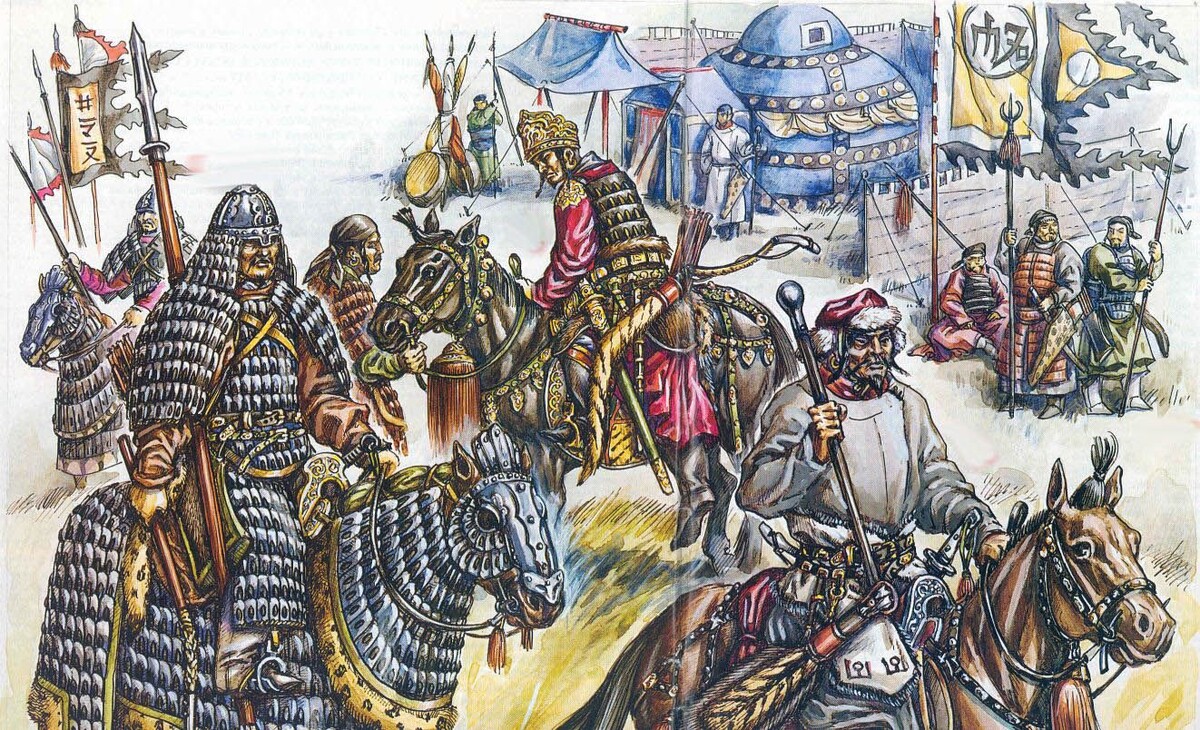
Aziz-Sheikh: a new khan from the Shiban clan
Having once again driven out Mamai’s troops, the Saray aristocracy decided to once again place their bets on the eastern branch of the Jochids. This time, the aristocracy of the Kok Horde chose Aziz-Sheikh (who ruled from 1364 to 1367), the son of Timur-Khoja and presumed descendant of Jochi Shiban’s son, as their protégé.
At the end of 1364, he was raised on a white koshma with the full consent of the Tatar clans, which allowed him to remain on the throne for quite a long time, which can only be explained by the support he received from the Sarai aristocracy. Like many of his predecessors, he fought an exhausting battle with Mamai, who launched a massive offensive against his opponents’ possessions. A year after the arrival of the new khan, Mamai’s troops occupied the entire North Caucasus, where coins were minted in Madzhar on behalf of his protégé, Khan Abdullah, in 767 AH (year of the Hijra) (August 18, 1365 – August 6, 1366).

Aziz-Sheikh orders the execution of Bulat-Temir
But already in the following year, 768 AH (August 7, 1366 – July 27, 1367), Abdullah’s coins were minted in Saray al-Jadid itself. Nathanzi, a historian who loved to reveal behind-the-scenes details of the private lives of the khans of the Ulus of Jochi, author of “Anonymous Iskander,” vaguely hints at some “nasty deeds” that Khan Aziz-Sheikh allegedly loved to do and which caused the rebellion against him. Most likely, Mamai’s offensive caused a split among the Sarai nobility, which again led to the overthrow and death of Aziz-Sheikh at the end of 1367.
This resulted in the weakening of the power of the clans from the Lower Volga region. Coin minting in Sarai practically ceased, and we have no other information from sources. The same author of “Anonymous Iskander” vaguely mentions the short reign of a certain Khadzhi Khan, son of the ruler of Kok-Orda Khan Erzen, after the death of Aziz-Sheikh, but this is the only information we have about this khan. It is not even clear where he ruled. Or whether he actually ruled at all. If Natanzi himself is not mistaken, which is quite possible, then it cannot be ruled out that this Haji Khan was proclaimed khan in the Kok Orda, but had no influence whatsoever on politics in Sarai. In any case, we have no other information about him.
Muhammad-Bulyak: Mamai’s new protégé

But while the central government had weakened considerably and the khans of Kok-Orda had lost interest in the struggle for Sarai, Karachibek Mamai’s power grew rapidly. In 1370, his daruga (special envoy) Achi-Khoja, together with the retinues of the Nizhny Novgorod prince Dmitry Konstantinovich, laid siege to Bolgar and, having deposed the local emir Hassan, appointed Mamai’s vassal, Sultan “Sultan Bakov’s son,” as ruler (“they placed him on the throne”). Thus, Mamai’s power was established throughout the Volga region, where he brought all the previously semi-independent rulers under his control. He practically became the ruler of the entire Ak Horde.
However, during the period of his greatest power, some internal processes took place in his possessions that weakened his power. The details of this are unknown, but it was precisely from the early 1370s that his power began to gradually weaken. It was in 1370 that news reached Rus that “Mamai had installed another tsar, Mamat Saltan, in his Horde.” The fate of the former khan Abdullah remained unknown, but coins began to be minted in Mamai’s domains in the name of the new khan, Muhammad-Bulyak, “the just sultan Muhammad-khan.” Muhammad (Muhammad-Bulyak) (reigned in 1369-1380). He was a protégé of Karachibek Mamai, but his ancestry is unknown. Khan Muhammad-Bulyak ruled mainly in the western part of the Ulus of Jochi (Golden Horde) in Crimea, the Northern Black Sea region, and the North Caucasus, where coins were minted in his name. In 1372-73, he occupied the throne in Sarai al-Mahras. In the summer of 1379, he issued a tarhan yarlyk to Mitya (“Metropolitan Michael”), who unsuccessfully claimed power over the Orthodox diocese of Rus.
Tulunbek: the mysterious khan

Coins of Tulunbek-khanum.
The aristocracy from other clans took advantage of the weakening of Karachibek Mamai’s power and attempted to place their own khan on the throne. After a gap of almost five years, in 772 AH (July 15, 1371-2.07. 1372), coins began to be minted bearing the name of Khan H.M. Fren, later read by G.A. Fedorov-Davydov as “Tulunbek-khanum,” which raises serious doubts, since there are no female rulers known in the history of the Golden Horde. The small number of these coins and the lack of any information about this khan (presumably a female ruler) in written sources has led to the emergence of mutually exclusive versions in modern research concerning the origin of Tulunbek Khan and the interpretation of her name (from reading it as a male name in the works of V.L. Egorov before the error in the date was recognized and compared with Toktamish’s wife in the articles by A.P. Grigoriev). Be that as it may, further events show that Mamai’s power in the Lower Volga region weakened significantly, and a few months later, in 773 AH (July 16, 1371 – July 2, 1372), he had to reconquer Sarai. This obviously led to the overthrow of the mysterious ruler Tulunbek.
Be that as it may, this was Mamai’s greatest success. After this victory, his forces were depleted. He began to gradually lose one position after another, ceding power in the Ulus of Jochi to his opponents. The rulers of the eastern part of the country took the lead in the struggle against Mamai’s clan.