
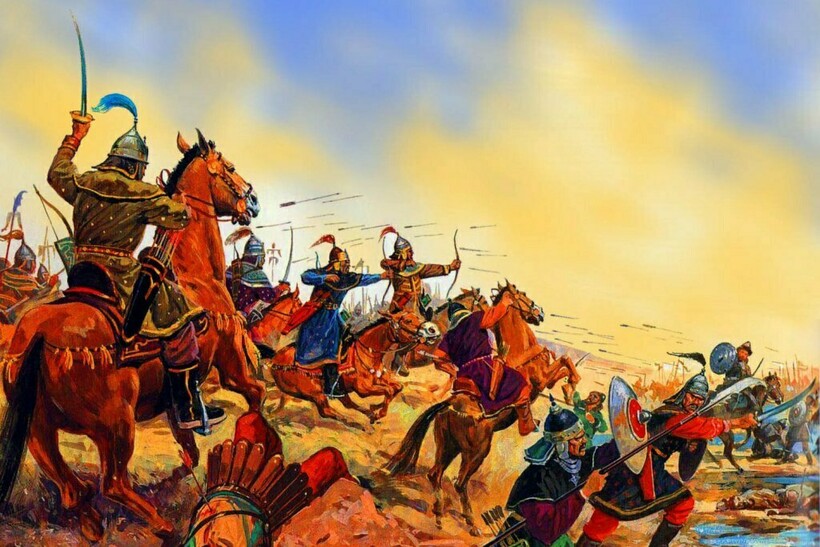
Murid: the East advances
Khan Murid (Murad-Khoja, known as Amurat in Russian chronicles), Khan of the Ulus of Jochi (Golden Horde) (1361-1363). Most likely, he was from the family of Khan Chimtai of the Kok Orda. He was called to the Sarai throne by the Tatar aristocracy. After defeating Khan Kildibek, he secured his position on the throne and, for a time, gained the loyalty of the aristocracy.
But in the fall of 1362, Ulusbek Mamai rose up against him again, bringing with him the “prince” Abdullah. In the battle on the right bank of the Volga (“Mamai and Murut fought on the Volga” [Ibid.]), Murid’s troops were defeated, and he retreated to the Trans-Volga region. Saray al-Jadid was recaptured by Mamai, but this did not bring him final victory. The only real result of this campaign was the recognition of his “prince” as “tsar.” But in the Volga region, there was another outbreak of the plague, and he, categorically refusing to use the support of the capital’s aristocracy, retreated to the west.

Mamay’s military halt.
Murid, who managed to resist Mamai’s ambitions, reestablished himself in the capital and in the Volga region. It is difficult to say who he relied on in this struggle, but in addition to the eastern troops, he was clearly supported by some clans of the Ak Horde.
Period of decline
Essentially, the Ulus of Jochi was divided into three large parts. One area was the European part of the Horde west of the Volga, where Ulusbek Mamai ruled on behalf of Khan Abdullah. In Russian chronicles, this area became known as the “Mamaev Horde.” the second was the Lower Volga region with its center in Sarai al-Jadida, which was called the “Murotova Horde,” and the third was the lands of the Kok Horde, whose khans sought to establish the power of their protégés over the entire Golden Horde. Of course, in reality there were many more such parts, which periodically appeared, were conquered, or disintegrated, especially on the outskirts of the country.
From this time on, the Ulus of Jochi began a long period of decline and gradual disintegration of the unified state. The ensuing civil strife brought with it a deterioration in the financial situation due to a decline in trade and craft production. As central authority weakened, the rulers of Rus, Bulgaria, Mukhshi, Khorezm, and other uluses strengthened their independence. In the context of civil strife, it was these relatively stable regions that became the targets of the khans’ struggle for tribute payments, manipulation of pretenders to power, and punitive raids. All these actions destroyed the established order and provoked a desire to defend their lands from the encroachments of the self-proclaimed Horde rulers.
The center and the regions: power is spreading
In 1361, Khorezm completely broke away from the Horde, where the local Sufi dynasty began to rule. At the same time, as a result of the khans’ repression of the clan aristocracy, they moved with their clans from the center to the periphery. Here they found support from the local nobility and created their own separate domains, sometimes even beginning to mint their own coins. Among such emirs, we can single out Beka Tagay, who ruled in Beljam, and in the early 1360s went north, where, according to the Russian chronicle, “Nuruchad (i.e., Ulus Mukhsh) took that country for himself, living and arriving there.” Here, safe from the turmoil in the center of the Horde, he established his domain and made frequent raids on neighboring Russian principalities. Only in 1365, after an unsuccessful raid on Pereyaslavl-Ryazansky, does information about him disappear. Perhaps, taking advantage of his defeat, he was simply overthrown by local beks.

Khorezm on the map of ancient historical regions of Central Asia
Another emir (“prince of the Horde”) Bulat-Timur, apparently the son of the famous Karachibek Toglu-bi, “took the Bulgarians and all the cities along the Volga and the uluses, and took away the entire Volga route,” effectively becoming the ruler of a semi-independent domain in 1360-1366. Bulat-Timur held power in Bolgar until 1367, when, after suffering defeat in the struggle with the princes of Nizhny Novgorod, he “fled from there to the Horde,” where he was executed by order of Khan Aziz-Sheikh. The ever-growing schism in the Ulus of Jochi was not the only consequence of the “zamytani.” At the same time, its prestige as a world power fell very low. Taking advantage of the turmoil, its neighbors began to tear its territory apart. Lithuanian Prince Olgerd, having defeated Mamai’s ulusbek troops in 1363 in the Battle of Blue Waters (a tributary of the Bug River), occupied all of Southern Rus, and later the entire Prut-Dniester interfluve fell under the rule of the Moldavian principality.
A sign of weakness
Under these conditions, various adventurers and robbers raised their heads. The northeastern Russian principalities, which were under the rule of the Golden Horde, received one after another a sign of the Horde’s weakness. This was demonstrated by the virtually unpunished raids of the Ushkuyniks in 1360, 1366, 1374, and 1375, in the latter case fighting their way across the entire Volga and only being destroyed in Khadzhi-Tarkhan by the ruler of the city of Cherkess.
Another equally important indicator of the inability to rule Rus was the dispute over the yarlyk for the grand duchy. In 1362, after sorting out the dispute between Dmitry Ivanovich of Moscow and Dmitry Konstantinovich of Suzdal, the khan’s envoys awarded the yarlyk to the Moscow prince. Upon learning of this, Mamai hastily sent a messenger with a yarlyk to the same prince on behalf of Abdullah. Then, contrary to his decision, Khan Murid demonstratively handed the yarlyk over to the prince of Suzdal. Dmitry Konstantinovich was unable to retain this title, but the new khan Aziz-Sheikh, who came to power in Sarai, seeking to establish a power hierarchy acceptable to him in Rus, once again ignored Abdullah’s letter and issued a letter to Suzdal, confirming Boris Konstantinovich as prince of Nizhny Novgorod.
The reaction of the Moscow prince
Such steps provoked harsh retaliatory measures on the part of the Moscow prince Dmitry Ivanovich and Mamai. This turmoil contributed to the growth of discontent among the vassal Russian princes, whose possessions not only became a toy in the hands of the khans, who changed with kaleidoscopic speed, but also served as the object of raids by rival pretenders to power in the Horde. These actions destroyed the stable order of the princes, introduced an element of instability, and provoked a desire to defend their lands from all external encroachments. The apotheosis of this was the war of the Moscow prince Dmitry Ivanovich against Mamai (1378-1380).

The militia of Grand Prince Dmitry Ivanovich in 1380. 17th-century lubok.
At the same time, the authority of the Ulus of Jochi was declining in the eyes of its traditional partners. The sultans of Egypt, who had recently declared their vassalage to its khans, now almost ceased correspondence. Mamai, who tried to maintain it, received letters in which the Egyptian sultan, humiliating him, referred to himself as his “parent” rather than his “brother,” as was customary according to protocol. Undoubtedly, knowing full well the situation in Dasht-i Kypchak, the Egyptians did not want to bind themselves in an alliance with one of the pretenders to power.
The raging civil war and the secession of a number of provinces, especially Crimea and Khorezm, also led to a deepening decline in trade and craft production. Due to the military threat, caravan routes ceased to function regularly, and as a result, the import of raw materials and the export of handicrafts were disrupted. The decline of agriculture and the desertion of settled communities in the Volga region continued.
Khayr-Bulat: the civil war continues.
Against this backdrop, the civil war intensified. In 1363, a certain Khayr-Bulat (Khayr-Pulad, Pulad-Khoja, Pulad-Timur) rose up against Murid. He drove Murid out of Saray to Gulistan and was proclaimed khan. But at the end of 1363, information about him disappears, and the last coins minted in his name date from September 1364. The author of “Anonymous Iskander,” Muin ad-Din Natangi, reporting the juicy details of the reasons for his death, indicates that the main actor in this conspiracy was Ulug Karachi-bek Ilyas ibn Toglu-bi. If we disregard the frivolous details that clearly discredited the deposed khan, we cannot rule out the possibility that the ruling clans simply decided to remove the entrenched khan in order to prevent the clans from the east from ousting them from power. At that time, Khair-Bulat apparently occupied the entire Volga region, including Gulistan. But his reign was short-lived.
Mamai raided the capital again and captured Sarai, because in 766 AH (09. 1364 – 08. 1365 AD) his protégé Khan Abdullah minted his own coin in Sarai al-Jadid. But he was also unable to remain in power in Sarai for long. Apparently, the clan aristocracy united again and drove him into the steppes of the Northern Black Sea region.