
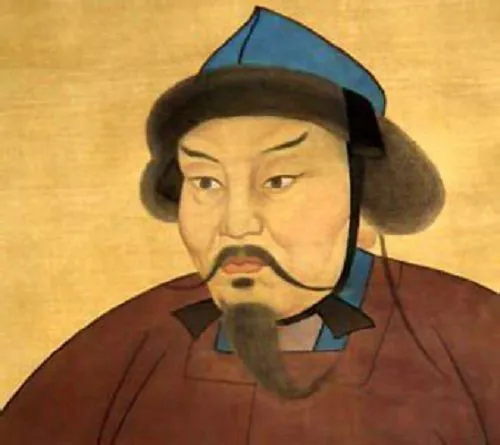
The cycle opens with a brief sketch about the life of the founder of the Golden Horde, Jochi, the eldest, but for a number of reasons unloved son of Genghis Khan, who was the first to receive the western part of the emerging empire, successfully fought against Khorezm Shah, but suddenly died at the peak of his glory and power. His life is a complex mix of family drama and the growing power of a new empire.
The mystery of birth
JOCHI (1184-1227), the eldest son of Genghis Khan, the founder of the Jochi Ulus (since 1208) and the founder of the Jochid dynasty.
Historians have been arguing about the date of Jochi’s birth for a long time, naming completely different dates (from 1179 to 1188), which is associated with dramatic events. In 1178, Temujin married Borte, the daughter of a khan from the Kungrat clan. Obviously, a year later, the couple had a daughter, and then disaster struck. During the struggle for power, the Taijuites, led by Temujin, were defeated by the Merkits in 1183, his kuren was plundered, and his pregnant wife was captured. After long negotiations, she was released and on her way home (in 1184 or early 1185) she gave birth to a son, whom her father greeted with the words: «A new guest has arrived safely!», which became his name (Jochi – «newly arrived guest».
So Jochi’s birth turned out to be forever linked to suspicions that he was not a real descendant of Genghis Khan. This issue was raised especially actively and with emphasis in various versions of this story with a clear anti-Juchid orientation, where he is called the «heir of the Merkit captivity.» At the same time, in the «Secret Legend» (1240) there is an episode when, analyzing a dispute between his sons, Genghis Khan heard similar accusations from other sons and ordered them: «Do not dare to utter such words in the future!».
Be that as it may, but during the life of Genghis Khan, no one dared to doubt his origin. Jochi accompanied his father from an early age, and already in his youth he was assigned to oversee the collective hunt. Clearly, he was being groomed for the role of ruler. He was mentored by outstanding companions, Boorchu and Subotei, who taught him how to handle weapons and tactics of steppe combat. Their training was not in vain. In 1203-1206, he took part in all the wars with the Merkits, Naimans and Kereits, proving himself to be a brave warrior and a skilled military leader.
New Ulus
In 1207-1208, Genghis Khan sent him at the head of a large army to conquer the Minusinsk Basin, the Baikal Region and Southern Siberia. Young Jochi was able not only to defeat the Kyrgyz who tried to resist, but also achieved their subjugation. From that moment on, the contingents of Kyrgyz, Turkish Humats, Tatars and Kimaks became the basis of his new tumens. After returning to Mongolia on the Kurultai, Genghis Khan allocated him lands from Altai and the Irtysh region to the extreme limits of the west, marking the beginning of a new ulus. In later writings, these possessions are described as follows: «an area stretching from Kayalyk (a city in the Semirechye region) and Khorezm to the extreme limits of Saksin and Bolgar and beyond, where only the hoof of the Tatar horse touched the ground.» 4,000 Mongols from Sijiut, Kingit and Khushin clans were assigned to him as an elite. In total, there were obviously 4 tumans under Jochi’s command, numbering from 20 to 40 thousand soldiers, which made him one of the notable military leaders.
In 1211, Jochi already commanded Mongol troops, including the tumens of his younger brothers Chagatai and Ogedei, who invaded the Jin Empire. After making the difficult crossing of the Gobi, these troops invaded Shanxi Province and operated north of the Great Wall of China. Here he defeated the Jurchen troops, who took refuge in fortified cities. Having ravaged the entire area, the Mongol troops retreated to the steppe. At the same time, other Mongol troops invaded in two columns, one of which besieged the northern capital Datong, but the siege failed, and Genghis Khan was forced to retreat to the steppe. In the following years, the campaigns resumed. Jochi is mentioned again among other generals. As a result of the Mongol attacks, the Jin Empire began to fall apart, and the Khitan relatives of the Mongols went over to their side.

The Jochi Ulus in 1206-1227.
In 1215, the war resumed, and Genghis Khan defeated Jin again and stormed its capital Zhongda, but by this time Jochi was sent to the west, where the remnants of the defeated tribes rallied around the Merkits and created a serious coalition of «Naimans, Kereits, Kangls and Kipchaks.» Tumens were directed against them, led by the invincible «dogs with iron hearts,» as Genghis Khan himself called them, bagatura Subotei and Tokhuchar.
At that time, Jochi himself had to suppress the sudden uprising of the Khori-Tumats and Kyrgyz. At the end of 1216, his tumens moved down the ice-covered Yenisei, crushing the rebellious tribes. And in the spring of 1217 they went to the Irtysh region, joining the tumens of Tsubodai. After this victorious campaign, Genghis Khan confirmed the right of Jochi to these possessions, granting «all regions and the ulus located within the rivers of the Irtysh and Altai Mountains, summer and winter nomads,» that is, he more clearly and specifically defined the eastern limits of the Ulus of Jochi, its indigenous lot. It is important to emphasize that it was here that the lands of the Tatars, the ruling family of the former Kimak khaganate, were located. They became part of the new ulus and were included in its elite, as Rashid al-Din wrote about it, saying that the troops of the Kipchaks, Majars and others «joined them.»
The War for Khorezm
At the head of his tumens, Jochi began the persecution of the Merkits and the conquest of the steppes of Eurasia, but in the area of the Irgiz River he encountered the troops of Khorezmshah. During a short battle, Jochi defeated the Khorezmians’ left flank, but were forced to retreat.
Returning to Genghis Khan’s headquarters, Jochi faced the intrigues of his brothers in a victorious halo. They did not want to recognize him as the heir to the throne, putting forward as the heir the right of a minor, that is, the right of the younger to the paternal ulus, while the older ones were to receive their possessions from conquests. It came to a verbal altercation and quarrel. It was the first peal of the future thunder of the brothers’ mutual enmity.
Internal strife was stopped by a new major war with Khorezm. The Mongol troops, as it became a tradition, invaded in the autumn of 1219 in several columns, preventing Khorezmshah from organizing a unified resistance. He fled to the west in fear, and the Mongol troops captured the country in parts. Jochi, following this plan and a preliminary agreement, invaded from the north and began to storm the cities along the banks of the Syr Darya. He took Sygnak, Uzgend, and took Jend. At the beginning of 1220, he moved to Urchench and besieged it. Ogedei and Chagatai’s troops soon approached the capital of Khorezm. The siege, thanks to the steadfastness of the defenders, dragged on for six months, but after a decisive assault, the city was taken and burned.
Death on the hunt

The mausoleum of Jochi Khan on the Kazpost stamp, 2014
After that, Jochi returned to his ulus, equipping it, distributing possessions to his nukers and forming new troops for further conquests. In the summer of 1224, at the Kurultai, his rights to possessions in the west were confirmed, but the unsuccessful campaign of Subotei and Jebe against Bulgaria showed that the expansion of the ulus to the west would not be an easy matter. That is why the military service class was quickly replenished by representatives of the local elite, who were included in the clan system of the Jochi Ulus. Gradually, the Jochi possessions expanded to the west and reached the Southern Urals and the Trans-Volga region by 1227.
By this time, the intrigues surrounding his inheritance rights were growing. Our sources are dimly reporting on Genghis Khan’s dissatisfaction with the slow progress to the west and the removal of Jochi from internal Mongolian affairs, but whether there was an open gap or whether everything remained a smoldering conflict remains unknown. The writer Vasily Yan, who carefully studied this information and sensitively followed the internal logic of events, suggested that Jochi was killed as a result of a conspiracy. He said something that historians are still afraid to say openly.
Indeed, it is hard to believe that a young forty-two-year-old man full of strength and health would suddenly accidentally die while hunting. But it happened at the end of February 1227. Rather, we should assume some kind of conspiracy of the brothers. Realizing this, Genghis Khan hastened shortly before his death to appoint his son Batu as Jochi’s heir, and not one of his sons.
Thus ended the bright fate of a young man who showed extraordinary talents as a commander and administrator, but who carried the shadow of suspicion and slander all his life. Nevertheless, Jochi was able to leave his sons not only his inheritance, but also the dream of conquering the far West, creating their own Ulus, which they successfully realized.