
Brother and colleague
Berke (Batu Khan, Batu, Sain Khan) (1209-1266), son of Jochi and grandson of Genghis Khan, younger brother of Batu. It is believed that his mother was the daughter of Khorezm Shah Muhammad, who gave birth to Jochi at least three sons –Berke, Berkechar and Buri. It is possible that they received their first knowledge about Islam from their mother. Like other people of the medieval steppes, we know almost nothing about his childhood. It is only clear that he, along with other brothers, studied the usual activities – tending horses, riding across the steppe, shooting arrows and listening to stories about great ancestors, dreaming of surpassing their deeds. Together with other brothers, he fought against the Bulgars in the steppes of the Trans-Volga region and rose as a commander.
During the great campaign to the West, he did not get lost among many other Genghisids and became famous for his successes in the war against the Kipchaks. During the march to Europe, he commanded Tumen as part of the army under the command of Batu, who invaded Hungary. He participated in the victorious battle on the Chaillot River (1241) and the storming of fortresses in Dalmatia.
Construction of a new ulus
After returning from a campaign during the construction of a new ulus, Berke received possessions in the North Caucasus, where he began to surround himself with Muslims. He introduced Muslim rules in his headquarters. The ambassador of the French king, Guillaume de Rubruck, who visited Berke’s headquarters in 1253, noted that animals were slaughtered for a feast according to Muslim custom and it was forbidden to eat pork there. The Arab-Persian tradition, in turn, passed on rumors that Berke learned to read the Koran from a young age, and accepted Islam from the Sufi sheikh Sayf al-Din Boharzi from Bukhara.
In any case, his authority among the elite was significant. It was he and his son Sartak Batu who in 1251 entrusted the important task of enthroning his cousin Kagan Munke to the throne of the great Khan. They were familiar and, apparently, even friendly, since they stormed Kiev together with Munke. As weighty arguments in favor of such a choice, he was given three regiments of armored cavalry. The Kurultai was successful, and Munke became the great khan, which was a brilliant diplomatic victory for the Jochids. In fact, Batu’s status has become comparable to that of the ruling great Khan.
Berke’s success made him one of the most influential Jochids. But fearing the strengthening of his influence, Batu Khan in 1252 transferred him to a ulus in the steppe Trans-Volga region away from the center of the Horde. Obviously, this was the beginning of a struggle among the country’s elite to choose a path of development – subordination to the great khans or strengthening independence. The crisis in the Mongol Empire intensified due to the conquest of Iran by Hulagu, which the Jochids viewed as an invasion of their area of interest.

The Muslim on the throne
In 1256, Batu Khan died, which made the internal struggle open. In fact, the dispute was about the way to further develop the Jochi Ulus as an independent khanate or vassal of the great khan, who disregarded the interests of the local elite. After two years of conspiracies and rebellions, Batu’s direct heirs were killed, and Berke was elevated to the khan’s throne.
Berke’s rise to power strengthened the movement towards independence. Although he did not shy away from carrying out common Mongolian enterprises, he completed the population census, expanded the privileges of European merchants and streamlined the taxation system, and Basque governors were appointed to the conquered countries. But under him, for the first time, the minting of coins with the tamga of the Jochids was started, and a unified monetary and weighing system was established. During Berke’s reign, urban planning, crafts and trade were developed. One of the main reforms was the proclamation of Islam by his faith, he began building mosques and attracting Muslim theologians.
At the same time, Berke sought to gain the support of the Russian princes. He tried to minimize the influence of the great Kaan and switch the management of Russia to his officials. Berke sought to protect his possessions in Russia from the encroachments of the Order. There is a known case when the arrival of the Tatar embassy in Novgorod stopped the raid of the knights of the Order on the Russian border. He established an Orthodox diocese in Sarai al-Mahrusa (1261) and promoted the development of domestic trade. At the same time, he drew special attention to the independence and independent policy of Daniil Galitsky. He appointed the famous commander Burundai as the ruler of the western ulus, who was able to weaken the power of the Galician princes by military force and diplomatic pressure and make them allies in the struggle for Poland. In 1259, Berke organized a new campaign against Poland, which, apparently, was supposed to be a new onslaught against the West. But even with the support of Russian troops, his results were limited – Sandomir was taken and burned, but he failed to conquer Poland. This was the last significant trip to the West. The main danger to the Jochid power suddenly arose in the south and east.
The War of Faith
Meanwhile, Khan Hulagu, who seized Iran, violating the treaty with the Jochids, seized all their possessions in Transcaucasia in 1258. It was there that the Great Silk Road passed, which brought enormous incomes. This led to conflict and a series of wars.

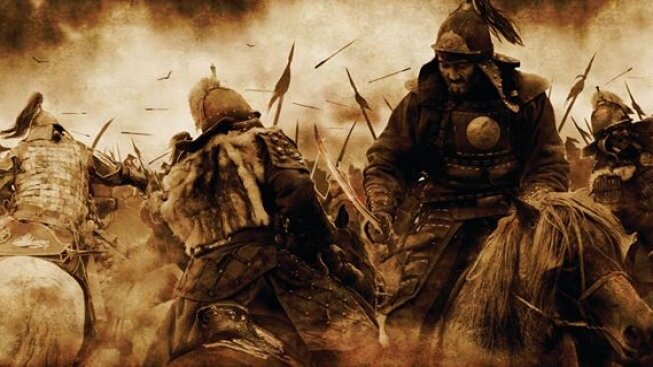
The battle between the troops of Berke and Hulagu.
Dagestan and Transcaucasia were the main theaters of military operations. The details of this war are described inconsistently by Arab authors, but it is clear that the war of equal rivals was characterized by ferocity and tenacity. Military operations began and unfolded in Northern Azerbaijan. In November 1262, Ilkhan Hulagu’s troops crossed the Kura River and marched to Derbent. Without waiting for the main forces to approach, the advanced troops under the command of Emir Nogai began the battle, but were defeated. Abaga entered the plain and began to advance north. The troops of Khan Berke advanced to meet them, who was forced to mobilize all his troops (literally 8 out of every ten). Already in January 1263, Berke conducted a brilliant maneuver and inflicted a crushing defeat on Hulagu’s troops in the Battle of Derbent. He got the victory at the cost of heavy losses. The witnesses narrate the words he allegedly said: «May Allah punish Hulaga! He forced Tatars to fight against Tatars. If there hadn’t been a battle between us, the Tatars would have taken over the whole world.»
Diplomatically, the enmity with Hulagu led Berke to an alliance with the Mamluks of Egypt and the Turkish sultans. Developing relations with them, Berke marched against Byzantium, which prevented contacts with Egypt, besieging Constantinople (1265) and gaining the right to free trade.
Berke died while returning from a campaign in Transcaucasia in 1266, after repelling an attack on Transcaucasia by Hulagu’s son, Abagi.
Khan Berke’s legacy is enormous – in fact, he defined the Islamic vector of development of politics and culture, and the Jochi Ulus actually isolated itself from the Mongol Empire. At the same time, he successfully continued to preserve and multiply the Batu heritage, developing his own ulus into a full-fledged empire.