
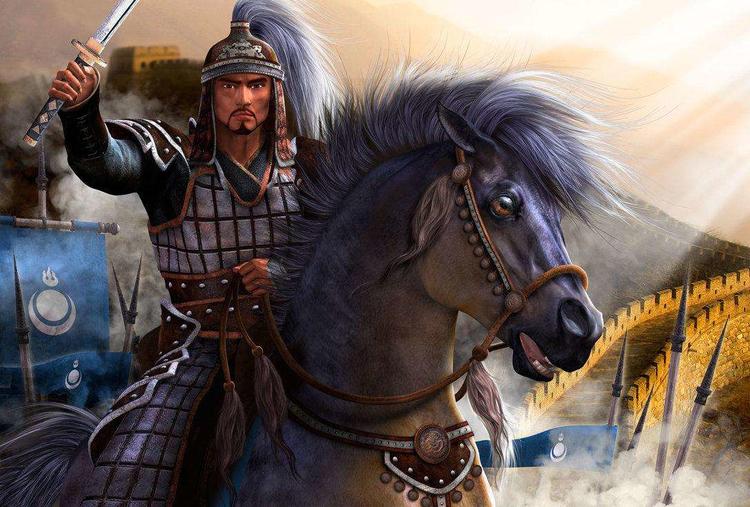
Sartak: the failed heir
Sartak (c. 1226-1256), the eldest son of Batu, Khan of the Ulus of Jochi (1256-1257). The date of his birth is not exactly known, but it can be assumed that the birth of Batu’s first child occurred after his marriage, before his proclamation as the ruler of the Jochi Ulus. The satrak was raised from his youth as the heir to the throne and accompanied his father in all his campaigns. In the western campaign of 1338-1242, according to some original Persian sources, he commanded a tuman and showed bravery. At the Battle of the Chaillot River (1241) he, commanding the advanced tumen, attacked the Hungarian troops and provoked their offensive, luring them into a trap.

The Battle of the Chaillot River. Miniature of the 13th century
After returning to the Volga region, he took part in the organization of power in the Golden Horde, performing important functions, in particular dealing with foreign policy issues. In 1253, he received the ambassador of the Pope and the French king Louis IX, Guillaume de Rubruck, who was on his way to the court of the great Kaan. He conducted negotiations with the ambassadors of other countries and possessions, in particular with the Armenian Church. But at the same time, he himself emphasized that he was acting on behalf of the Khan.
Sartak and his friendship with the Church
Russian Russian princes were supposed to be governed by Sartak’s position, but there is no reason to believe, as some historians do, that he held the position of «manager of Russian affairs.» In some cases, he exercised some authority, according to the instructions of the Batu. Such a case was the suppression of the Vladimir Prince Andrei Yaroslavich’s speech in 1252, when Nevry’s troops were sent against him. They defeated the prince and Na fled to his wife’s relatives in Scandinavia. After that, his brother Alexander received the label for the Vladimir Grand Duchy, who, apparently, informed Batu about his brother’s betrayal. From this fact, some historians (in particular L. Gumilev) conclude that there is some kind of fraternal relationship between Alexander Nevsky and Sartak, but there are no real facts about this.
It is well known from all Arab-Persian and Armenian writings that Sartak was a Christian, obviously of the Nestorian creed. This explains his actions, in particular, his desire to relieve the church of the burden of taxes. According to an Armenian historian and contemporary of the events, Sartak «greatly eased the situation of the church and Christians and, with the consent of his father, issued an order to exempt priests and the church from taxes.» At the same time, the influence of his faith on the internal politics and consciousness of Sartak himself should not be exaggerated. This was already clear to the Christians from Batu’s headquarters, who confided in de Rubroek: «Do not say that our lord is a Christian, he is not a Christian, but a «Moal» (i.e. Mongol), since the name «Christianity» seems to them to be the name of some people. They have exalted themselves to such great pride that although they may believe in Christ to some extent, they do not want to be called Christians, wanting their own name, that is, Moal.»

Sartak’s influence in the Jochi Ulus grew. In 1249-1251, he and Berke, at the head of thirty thousand troops, contributed to the ascension to the throne of the great Kaan Munke, the son of Tului. From that moment on, he began to enjoy the support of a part of the Tatar aristocracy, who sought to preserve a single empire and were Nestorians.
Shortly before his death in nasala in 1256, Batu sent Sartak to Karakorum to the great Kaan Munka for the kurultai of the Mongol aristocracy. It is obvious that it was there that Sartak received the news of his father’s death and obtained a label from the great kaan to own the Jochi Ulus. At that moment, a Jochid conspiracy was already brewing there, led by Berke and Berkechar, who were bypassed during the transfer of power from father to son. As soon as Sartak arrived at the headquarters in the Volga region, he suddenly fell ill and died suddenly. According to rumors, Sartak was poisoned by his uncle Berke.
So tragically and suddenly ended the life of perhaps one of the talented Jochid military leaders and politicians, whose rule could have led to the Christianization of the Jochi Ulus, which would undoubtedly have turned world history in a different direction. But reality, as always, rudely intervened in the events.
Ulagchi: Coup Attempt
After Sartak’s death, his supporters tried to rely on the authority of the great Kaan, who issued a new label. According to him, Ulagchi (Ulavchy) was proclaimed khan (about 1244-1257), and until he came of age, Borakchin-khatun, Batu’s widow, was to perform the duties of ruler. As one Persian source wrote, «Borakchin-khatun, the eldest of the wives (Batu), took over the management of state affairs and the upbringing of Sartak’s son, Ulagchi.»

Gleb Belozersky at Khan Ulagchi’s
After Khan Ulagchi ascended the throne in 1257, his supporters apparently decided to rely on their Christian subjects. Russian Russian chronicles have recorded a series of expressions of loyalty from the Russian princes. So, in particular, Rostov Prince Boris Vasilkovich himself went to the khan’s court to personally «honor» him. Prince Alexander Yaroslavich of Vladimir also not only sent gifts, but together with his previously exiled brother went to the new khan. At his court, they were treated kindly, and Andrei received forgiveness. Together with Andrey, where the latter received full forgiveness. Another issue that the Russian princes had to agree on was the issue of the population census conducted throughout the Mongol Empire (1257-1258).
The Horde Game of Thrones
But this time, the reign of the young khan was not long. In the same year, Ulagchi died, probably not without the help of Berke, who sought to seize power. But Batu Borakchin, a power-hungry and active widow, got in his way. She plotted on her own, seeking to enthrone another young son of Batu, Tam-Mengu, trying to enlist the support of Hulagu, who seized Iran, who was also a Nestorian. The plot failed, she tried to escape, but was captured and executed.
Thus, the actual first transfer of power to the Duchi showed that the Tatar aristocracy, with the support of the Jochid clan, is always stronger than any khan, and the succession to the throne is in the hands of this particular estate, and is not passed from father to son. Another lesson of these brief reigns was that Christianity did not enjoy the support of the aristocracy. Thus, the rule of these two khans shows that two possible alternatives to the development of the Jochi Ulus were missed and history continued its inexorable run, sweeping away some and elevating other politicians.