
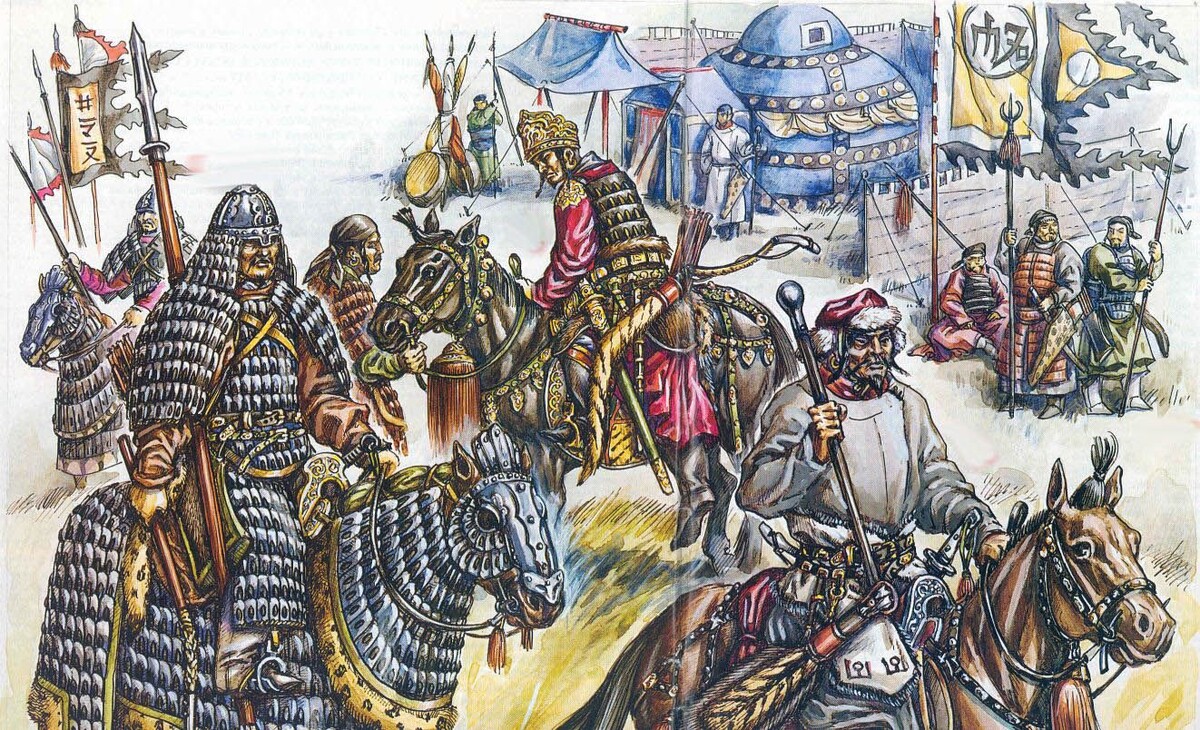
The Triumph of Islam
Uzbek, Sultan Muhammad (c. 1290-1342), Khan of the Ulus of Jochi (Golden Horde) (1312-1342). He was the son of Toghrulchi (Toghrulji), the illegitimate son of Mengu-Timur. He enjoyed the support of the city nobility and the army. He was appointed commander of the army that was gathering in the vicinity of Sarai for a campaign against the Russian principalities.

Portrait of Khan Uzbek in 1339 by A. Dalorto
But at this time, Khan Tokta suddenly died, and events began to unfold rapidly. He had named his son Ilbasmysh (Ilbasar) as his heir, but he had died a year before his father. The new heir was Tokta’s other son, Tugel-Buga, who was apparently supported by those circles of the aristocracy that were oriented towards Buddhism.
In his letter to the Egyptian sultan, as recounted by al-Nuwayri, Uzbek described the events as follows: «In his kingdom (Uzbek) there was still a band of people who did not profess Islam, but that he, having ascended the throne, gave them the choice of either converting to Islam or going to war, that they refused (to convert to Islam) and went into battle, that he attacked them, put them to flight, and destroyed them.» The late 14th-century author Ibn-Dukmak adds to this account with a story about the conspiracy of Kutlug-Timur, who, before enthroning Uzbek, “took his word that when he ascended the throne, he would become a Muslim and adhere to Islam.” In other words, Uzbek was actively supported by Ulug Karachibek Kutlug-Timur, Uzbek’s mother Bayalun. After the death of Tokta (winter 1313), Uzbek’s mother Bayalun and her brother Baytemir, who isolated the other Juchids and, relying on the army, organized the enthronement of Uzbek.
After Uzbek’s enthronement, according to Ibn-Dukmak, “he diligently embraced the faith of Allah and built himself a cathedral mosque, where he performed (all) five prayers at the appointed times,” for which “some of the Tatar emirs were indignant and gathered to overthrow him,” but their conspiracy was suppressed and the instigators were executed. In other words, having suppressed the resistance of some of the nomadic emirs—supporters of the Mongol orientation, mainly Nestorians and Buddhists—Uzbek executed his opponents. After coming to power, he began to pursue a policy of centralizing the country and declared Islam the state religion.
Khan the Reformer

Portrait of Uzbek from the Face Chronicle
Under Khan Uzbek, active urban development continued, and a new capital, Saray al-Jadid, was built. This city quickly grew into a real metropolis with a population of several tens of thousands. Interestingly, it was originally built as an Eastern city, not a Mongolian one, which apparently signified a desire to break with the old tradition.
Under Khan Uzbek, active construction of mosques, madrasas, and mausoleums began in the cities. They were built both in cities and in ordinary rural settlements. Turkish construction crews from Anatolia often served as builders. This clearly shows that Islam became the religion of the elite of society and spread widely throughout Northern Eurasia for the first time.
He pursued a policy of strengthening the currency and streamlining the tax system. Uzbek’s policy in the vassal lands was flexible and, instead of direct military pressure, relied on the vassal rulers themselves to collect taxes.
Trade with Genoa and Venice continued to develop and strengthen. A decree issued by Uzbek Khan in 1333 to the administration of the Venetian colony in Tana (near Azak) has been preserved, regulating trade, the rights and obligations of merchants and the Tatar authorities.
Moscow against Tver

Mikhail Yaroslavich of Tver with Khan Uzbek drawing by V. P. Vereshchagin
Among the Russian principalities, contradictions between Tver and Moscow intensified, leading to tragic consequences and fateful changes. Mikhail of Tver had been Grand Prince of Vladimir since 1304. In 1313, Khan Uzbek gave him a new yarlyk and summoned Yuri of Moscow to his headquarters, intending to punish him. Yuri spent two years in Sarai. He managed to win the favor of Uzbek, who in 1317 gave him a yarlik for the grand duchy and even the hand of his sister Konchaka.
This provoked fierce resistance from Mikhail of Tver, who refused to hand over the yarlik for the grand duchy and defeated Yuri Danilovich. He captured Konchaka, who died in captivity. This disobedience enraged the khan. Tver was besieged by Tatar and Muscovite troops under the command of Karachibek Kavgady and surrendered. In response to the rebellion, the khan ordered the execution of the Tver princes Mikhail (1318) and his son Dmitry (1325). Later, after the uprising in Tver and as a result of Ivan Kalita’s intrigues, Mikhail’s other son, the Tver prince Alexander, was executed, and Tver was captured and burned. The defeat of Tver strengthened Moscow, whose princes became loyal vassals of Uzbek, which consolidated the khan’s power in Rus. The rise of Moscow was fateful for the future of not only Rus, but the whole of Eurasia.
Between the Nile and the Volga
Under Uzbek Khan, hostilities with the Ilkhanate continued. Although Uzbek had been trying to establish diplomatic relations since 1314, in 1315 the rebellious Juchid Baba-ogul, supported by the Ilkhans, raided Khwarezm. In response, Uzbek attempted to invade Transcaucasia (1318-19), but was stopped.
A new war broke out in 1326, but it was also unsuccessful. The next round of conflict occurred in 1335, when Ilkhan Abu Sa’id died, and Uzbek decided to take advantage of this to launch an offensive in Transcaucasia. But even in this case, the Juchid troops did not achieve significant success.
The weakening of the conflict between the Hulaguids and the Juchids was largely due to the stabilization of the border between Mamluk Egypt. In turn, relations between the khans of the Ulus Juchi and the sultans of Egypt became regular. Under Uzbek, the already familiar military-diplomatic alliance against the Ilkhanids was complemented by religious and dynastic ties, including the marriage of Uzbek’s sister Tulunbia to Sultan Nasir ad-Din (1319-20). This alliance lasted for almost eight years, after which the sultan divorced her and married her to his emir. Although Uzbek’s ambassadors complained about this several times, it had no effect. As the threat from the Hulaguids weakened, the alliance between the Golden Horde and Egypt ceased to play an important role in world politics.
Under Khan Uzbek, pressure on the countries of Central Asia intensified. In the early 1330s, border wars with Hungary took place. Later, war broke out with Poland, which claimed the lands of Western and Southwestern Rus, which paid tribute to the Golden Horde. In response, in 1339, the Russian-Tatar army attacked Smolensk, and in 1341-1342, Tatar troops invaded Poland and ravaged the vicinity of Lublin and Sandomierz. These campaigns were intended to weaken the pressure of Poland and Lithuania on the possessions of the Jochids.

The death of Khan Uzbek. Miniature from the Face Chronicle
But in the midst of these campaigns, in 1342, Uzbek Khan died.
The reign of Khan Uzbek was an era of the highest flourishing of urban culture and the rise of the military power of the Ulus of Jochi, strengthening its international authority. From this moment on, Islamic civilization became the defining force in the political and cultural development of the Ulus of Jochi. The medieval Tatar state thus became the center of Islam in the north, and it was not without reason that Arab diplomats respectfully called Khan Uzbek “the sword of Islam in the northern lands.”