
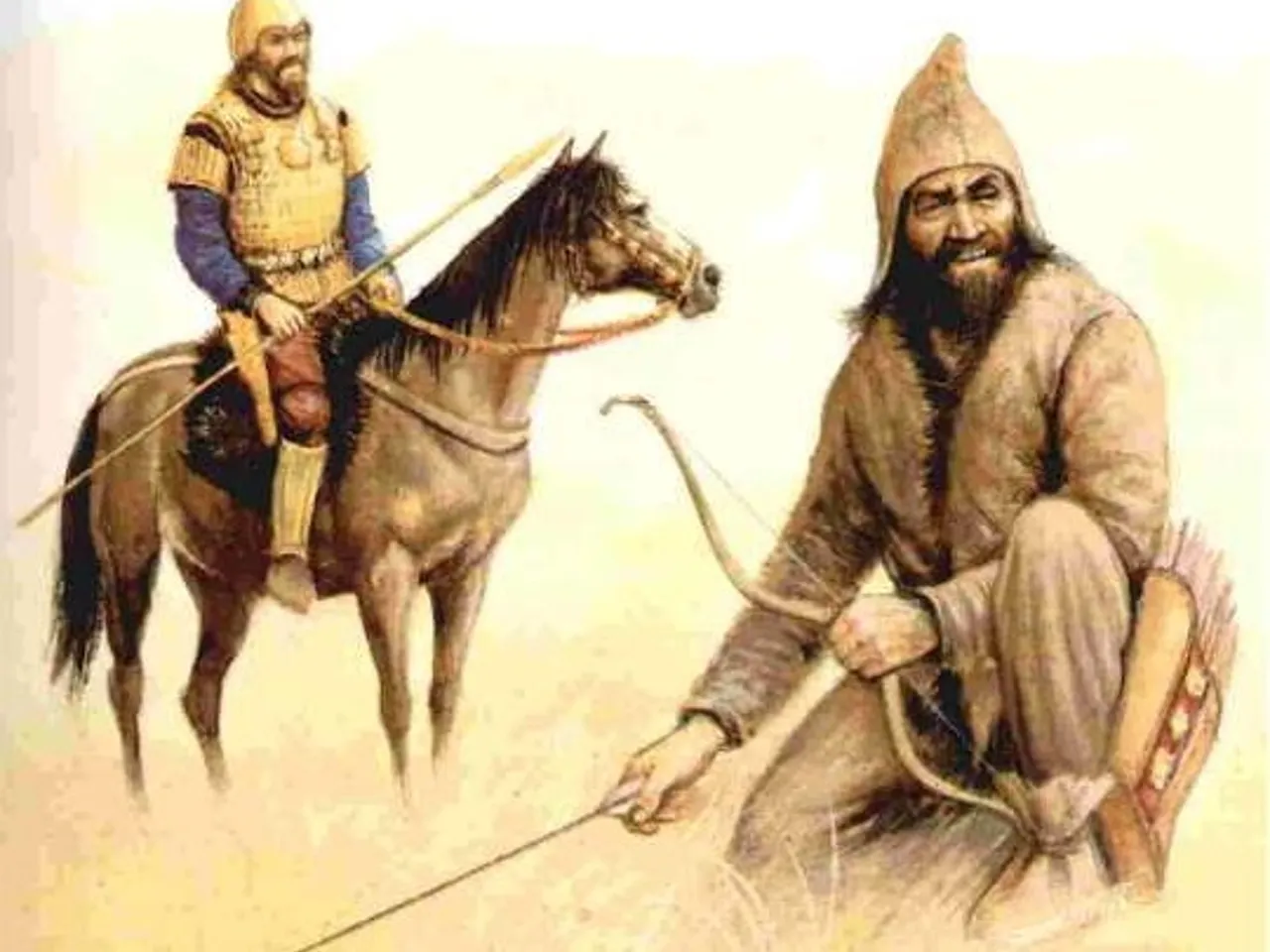
Many people have heard about the Huns, because their invasion completely changed the way of life in Europe. They are often portrayed as ferocious barbarians who came from Asia, fierce warlike nomads who easily conquered new lands. Moreover, they managed to finally defeat the once mighty Roman Empire.
But no one can say for sure what the Huns were like today. There are many mysterious episodes in the history of this people, and the past of the Huns asks many more questions than there are answers. Nevertheless, it is safe to say that these were the great conquerors of their time. How did the Huns appear? And why did they disappear?
The appearance of the Huns
There are several versions about the origin of the Huns, but the most common view is that their ancestors were the Xiongnu, nomadic tribes that occupied northern China. However, the Xiongnu had a difficult relationship with the Chinese peoples.
In an effort to conquer new lands, they constantly attacked the borders of China. The result was the defeat of the Xiongnu, after which the people were divided into several branches. The western group moved towards Mongolia, Russia and European countries.
Along the way, mixing with local ethnic groups, the Xiongnu transformed, and their culture acquired borrowings. This is how their descendants, the Huns, appeared, which became even more powerful conquerors than their ancestors.
The first mentions of the Huns as a people are found in Chinese sources dating back to the II century BC. In the records of Europeans, the Huns are mentioned four centuries later, but the heyday of this people begins in the IV century BC.
During this period, the Huns successfully attacked the Alans, whose lands were located in the North Caucasus, after which they launched an offensive against the Ostrogoths, whose state faltered under the onslaught of warlike nomads. The neighbors of the conquered tribes, the Visigoths, having learned about the invasion of the Huns, retreat to the Thracian territories.
The Huns are a nation of warriors
The Huns were renowned as invincible warriors, which is what prompted the rulers of the Western Roman Empire to ally with formidable tribes. The Huns successfully guarded the borders from Germanic tribes, but regularly raided the outskirts of the Eastern Roman Empire.
However, the Romans could not tell the Huns. In the 5th century, the Eastern Roman Emperor Theodosius II decided to pay tribute to the nomads — this helped to restrain them.
How did the Huns manage to conquer new lands so easily, with lightning speed? It seems to me that the reason lay both in the talent of the generals and the warlike disposition of the people themselves, as well as in the lifestyle of these people. The ancient Roman historian Ammianus Marcellinus wrote:
“The Huns never hide behind any buildings, abhorring them as tombs.… Wandering through the mountains and forests, they learn from the cradle to endure cold, hunger and thirst.”
Like any nomadic people, the Huns were in awe of horses, which were companions in battle, loyal helpers, and food sources. At the same time, the unusual appearance of the Huns alone terrified the Greeks and Romans.
The same Ammianus Marcellinus notes:
“They all have thick and sturdy arms and legs, thick necks, and generally such a monstrous and terrifying appearance that they can be mistaken for bipedal animals.”
The Huns led by Attila
I want to point out that many Hun leaders set an example for their subjects. They pursued a harsh policy, practically did not compromise, and demanded concessions from even the most powerful opponents.
For example, the leader Rugila, having learned about the fugitives who were sheltered in the Eastern Roman Empire, demanded the immediate return of the criminals, otherwise the Hunnic troops would march against the emperor. But the most famous Hun leader was Rugila’s nephew, Attila. The historian Priscus Panius noted in his writings:
“Attila is a man who was born to shake the world.”
Under this leader, the Huns’ territories expanded to unimaginable limits. Under his command, the troops took more than fifty large and fortified cities.The Huns even managed to invade Italy and occupy several regions, but the Romans put up serious resistance, which is why Attila’s army retreated.
The Fall of the Hun Empire
After Attila’s death in 453, strife and a struggle for power began among the nomads. The weakening of the Huns becomes a great opportunity to restore their rights to the conquered peoples.
The Gepids were the first to take advantage of this, launching an offensive against the Huns. A year after the death of their famous leader, the nomads suffered a crushing defeat.
Under the constant onslaught of tribes that had once been forced to obey them, the Huns retreated to the shores of the Black Sea. They made several attempts to break through to the Balkan Peninsula, but all of them ended unsuccessfully.
Having been defeated during the Great Migration, the Huns were doomed to join the new tribes arriving from the east. They disappeared among them extremely quickly. Despite this, even in the Middle Ages, some historians used the name “Huns” as a definition for nomads who arrived in Europe from Asia.
It is known that in the VI-VIII centuries in Dagestan there was an association called in some ancient sources the “kingdom of the Huns”, but researchers still cannot say for sure whether these were the same conquering Huns who were pushed back to the mountains, or local tribes mistakenly called Huns.