
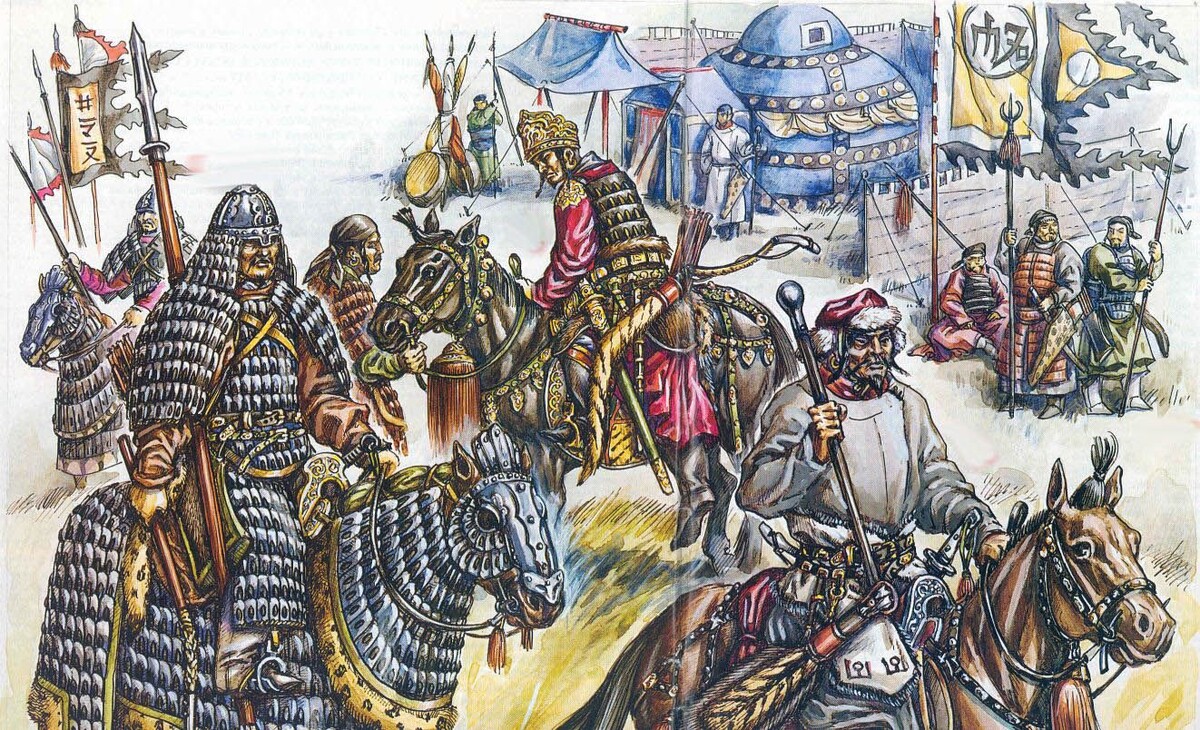
In 1037, the Turkic Seljuk Empire appeared on the map of the Middle East literally out of nowhere and quickly began to spread its influence. No one could resist the Seljuk Turks — neither the Byzantine Empire, nor the Ghaznavid state, nor the Georgian kingdom, nor the Shiite confederations of Iran, which were guaranteed to be crushed by the Seljuk strike force, the backbone of which was their heavy cavalry — the gazis.

Seljuk gaziz of the 13th century.
Originating from Parthia (now the territory of Turkmenistan), the Seljuk Turks always knew a thing or two about good horses and heavy cavalry, which they named gaziz (“strong ones”), However, since the name Gaziz is quite common in Kazakhstan and Kyrgyzstan, this suggests that the Yenisei Kyrgyz also took an active part in building the Seljuk army and the Seljuk Empire itself. The gaziz were recruited from among the mukta, a class of servants obliged to perform military service in exchange for the ikta, or land grants, from which the Seljuk feudal lord fed himself and his family and equipped himself for war. Since the material well-being and very life of a gazi depended entirely on his military skills, the utmost attention was paid to his training, and both future gazis and veterans spent all their time in grueling training in horse riding and in the use of weapons, consisting of long spears, polearms, sabers, and swords. Significant importance was also attached to the game of polo, which improved the skills of riders and horses, as well as discipline and teamwork, which were the cornerstones of the ghazis’ power.

Polo players.

Seljuk cavalry attack.
In battle, the gazis, clad entirely in armor and riding similarly armored horses, acted as follows: under the cover of mounted archers, the gazis lined up in a wave formation (with the center protruding strongly forward) and at the decisive moment rushed at the enemy, sweeping them off the face of the earth. In addition to such a massive attack, the ghazis also actively maneuvered on the battlefield, striking the enemy from all sides with the forces of units and individual warriors, staging feigned retreats and counterattacking decisively. “The scourge of God,” “punishment for the sins of mankind” — this is how the Seljuk Turks and their striking force of gazis were called by all those who had the misfortune to encounter them on the battlefield.

The Battle of Manzikert, August 25-26, 1071.

Crusaders in Palestine.
In 1095, the Byzantine emperor Alexius I Comnenus, finally defeated by the Seljuks, requested help from Western Europe, which was provided in the form of the Crusades. In the first battles with the Seljuks, the European knights were defeated, after which they adopted the Seljuks’ tactics and began to defeat them, taking Jerusalem on July 15, 1099. This defeat, followed by a series of further blows from the Crusader states and the Kingdom of Georgia, crushed the power of the Seljuk Empire, It broke up into a number of states that began to fight each other, and the Seljuk ghazis actively continued to destroy each other until 1307, when the last Seljuk state, the Sultanate of Konya in Asia Minor, fell.

The Battle of Katvan on September 9, 1141, marked the end of Seljuk rule.