
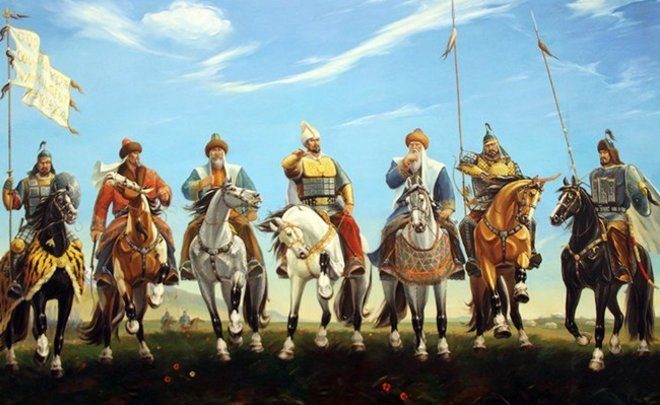
Thanks to modern research, the exact time of the appearance of the Kazakhs as a homogeneous ethnogenetic community has been clarified — it falls on the period between 1230-1340, that is, the heyday of the Mongol Empire and the Golden Horde. During this era, there was a mixture of newcomer Mongol and Turkic-Mongolian tribes from East Asia with local ancient Turkic tribes — Kipchaks, Karluks and many others. (Based on the scientific article «The Genetic Legacy of the Evolution of Turkish-Speaking Nomads across Eurasia»)
In this article, I want to analyze the genetic origin of genera (tribes). The middle zhuz of the Kazakhs
Argyns
The Argyn family is the most numerous family in Kazakhstan, according to scientists, there are now more than 2.1 million people.
According to the Kazakh folk genialogy (shezhere), the Argyns are descendants of the Golden Horde emir Karakhodzhi, who lived in the late 14th and early 15th centuries. This famous emir was an associate and nuker-associate of Khan Tokhtamysh, mentioned in the heroic epic «Edigey».

Karakhoja is one of the outstanding emirs of the Khan of the Golden Horde- Tokhtamysh. In the epic «Edigey» Khan Tokhtamysh addresses Karakhoja as follows: «… You are terrible to numerous enemies. You stood against them like a storm, Like a fog, you stood, frowning! My batyr Kara Kuja, Come into my house and say poetry!» The image is taken from an open source.
His father was the legendary Akzhol biy, advisor to Khan Abulkhair, and his grandfather was Kodan-taishi, who was the great bey, akyn, and chief advisor to the Khan of the Golden Horde, Urus Khan.
Also, the uranus (ancestral cry) of the Argyns was Karakhoja and Akzhol biy.
Many researchers of the 19th and 20th centuries- Ch. Valikhanov, M. Tynyshpaev, and others. The origin of the Argyns was attributed to the Mongolian Argun tribe of the Chagatai ulus or Hulagu Ulus. However, the origin of the Argyn tribe from the Mongolian Argun tribe has not been genetically confirmed, since the dominant number of representatives of this genus in Kazakhstan have the G1 haplogroup on the Y chromosome (up to 67%).

The leading haplogroup G1 among Argyns is highlighted in yellow on the diagram. Own image from a scientific work.
The genetic distance of the Argyn family is minimal with many peoples of Iran. They are close to the Pashtuns and even many peoples of the Caucasus — and this fact undoubtedly denies their Mongolian origin.
Representatives of the Argyn subgenus of Tarakta have the Middle Eastern and Caucasian haplogroup J1.
In addition, a comprehensive analysis of argyns from all over Kazakhstan proved that 80% of the tested representatives of this genus come from a single ancestor who lived 700 years ago. Thus, modern genetic studies have confirmed the version of the Kazakh national genealogy about the origin of the Argyns from the Golden Horde emir Karakhodzha.
The Naimans
The Naiman family is one of the largest families of Kazakhs, currently more than a million people who identify themselves as Naimans live in Kazakhstan.
The Naimans in the 10th and 13th centuries lived in the territory of modern Western Mongolia and Eastern Kazakhstan, probably descended from the ancient Turks-Segiz-Oguz (the Turkic word «segiz» and the Mongolian «Naiman» mean eight). Office work was conducted in the Old Uygur language.
After being conquered by Genghis Khan, they became part of the Mongol Empire, and were mostly resettled on the territory of the Golden Horde and Chagatai Ulus, where they continued to serve the Timurid state, and were also known in the Yuan Empire.
For Kazakh Naimans, the Y-chromosomal haplogroup O2a is predominant (from 48% to more than 60%)

The dominant haplogroup O2a among Kazakh Naimans is highlighted in gray on the diagram. Own image from a scientific work.
Haplogroup O2a is one of the oldest Asian haplogroups, it is characteristic of East Asia, especially the Sino-Tibetan peoples — ethnic Han Chinese, Vietnamese, Thais, and other peoples of Southeast Asia. Among the Khalkha Mongols, there are about 15%.
The Kipchaks
The Kipchak clan is a large tribe of Kazakhs in the Middle Zhuz, there are currently more than 700 thousand of them. They are descendants of the ancient Kipchak Turks, who in the 10th and 13th centuries were the rulers of the steppes from the Danube to the Altai, that is, Desht-i-Kipchak. They were numerous in the Golden Horde, and in the 15th century they were part of the Khanate of Abulkhair.
The most common Y-chromosome haplogroups among Kazakh gypsies are R1b-M478- about 47% and R1b-M269- 9%

The prevailing haplogroups R1b-M478 and R1b-M269 among the Kazakh Kipchaks are highlighted in lettuce and dirty green in the diagram. Own image from a scientific work.
Despite the fact that haplogroup R1b mainly belongs to Western European peoples (for example, in Spain, the frequency of R1b reaches 70%), the second focus of its distribution is in Eastern Europe and Central Asia. Among the Bashkirs of the Burzyan, the Gain clan and others, these subclades, similar to the Kazakh Kipshaks, reach concentrations of up to 87%, among the Turkmen- 37%, the Uighurs-17%, and also in Altai, among the Turkic people of the Kumandins — more than 43%, which was an unexpected discovery for researchers.
As a result, many genetic scientists believe that R1b is one of the original ancient Turkic haplogroups that spread from Altai.
The Huntsmen
The Konyrat family is widespread among the Kazakhs of Central and Northern Kazakhstan, currently numbering more than a thousand people. The Konyrats are descended from the Darlequin Mongols of the Kongirats. They were a privileged tribe during the Mongol Empire, as Genghis Khan and his descendants took wives from kongirats. For example, the wife of Genghis Khan’s father Yesugei-bagatura-Hoelun was from the Olkhonkhut branch of the Hongirats, Borte, the first wife of Genghis Khan, was also from the Kongirats. This tradition of marriage with this tribe was also continued by the ruling house of the Timurids. The legendary hero Alpamysh-Batyr came from the Kongirat tribe, whose epic of the same name was known among many Turkic peoples.
They became part of the Golden Horde and played a significant role in the political life of this state.
Among Kazakh Konyrats , the dominant haplogroup is C2-M407 , with more than 86%

The dominant haplogroup C2-M407 among Kazakh Konyrats is highlighted in dark blue on the diagram. Own image from a scientific work.
According to the conducted research, haplogroup C2-M407 is most common among the Mongolian Bargut tribe with a concentration of 55% and the Buryat people-about 29%. It is also found among the Oirats of Mongolia-10%, in Inner Mongolia of the PRC — 21%.
Kerey
The Kery family is the most widespread among the Kazakhs of Northern Kazakhstan, as well as among the Mongolian Kazakhs of Bayan-Ulgiya and Ili-Kazakh Autonomous Okrug in China.

Kazakh golden eagles from Mongolia. Image source : https://historicaldis.ru/blog/43224891654/Kazahi-v-Mongolii:-ohota-s-berkutami-%2825-foto-+-video%29 . Open source.
The Kerei are descendants of the Darlekin-Mongol Kereit tribe, whose representatives lived in the 10th-13th century in southern Mongolia. It is known that they professed Nestorian Christianity, which was adopted by the Khan of the Kereites in 1007 and received the baptismal name Mark. Later, they became part of the Mongol Empire.
The Y-chromosomal haplogroup C2-M217- 66-75 is the most common among the Keres of Kazakhstan.%
This haplogroup is the most common among the Khalkha Mongols, the concentration of C2-M217 among them reaches more than 51-54%, and also among the Bargut ethnic group — about 11%.

The C2-M217 haplogroup, which is the leading one among the Kerei, is highlighted in light blue. Own image from a scientific work.
The Average Zhuz is characterized by the highest genetic diversity, unlike the Younger and Older Zhuz. This proves the different origins of the tribes from different ethnic groups and forefathers of the past, as well as those formed at different times.