
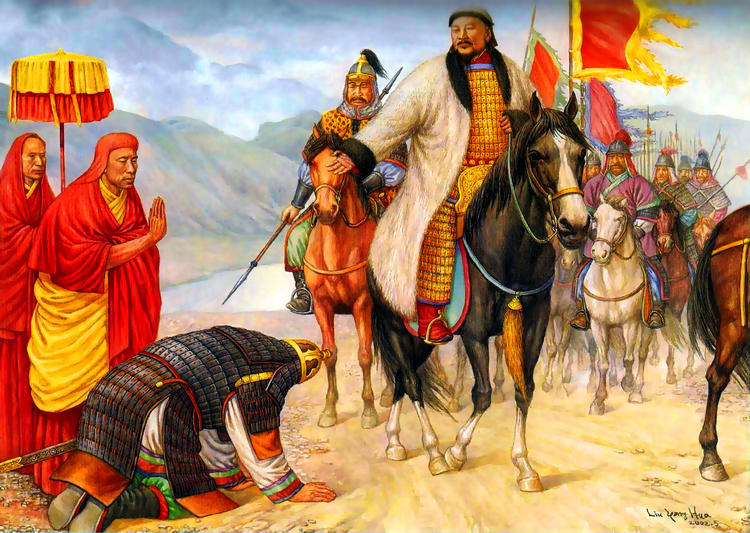
After defeating the Chinese cavalry in 90 BC, the Xiongnu did not proceed to conquer China. The reason for this was not the peacefulness of the nomads, but the enormous influence of Chinese culture and economy on the life of the Xiongnu. If the nomads had ravaged the country, who would have supplied them with the various Chinese delicacies that their children loved so much and the Chinese silks that their wives could not do without?
Of course, not everyone in Xiongnu society liked this. First and foremost, the old warriors from the four tumens of mounted archers, which were created under Mode. And the servants from the Shanyu’s state apparatus, who were paid in Chinese silk and rice — but only from tribute or spoils. And if there was no war, there was no tribute and no spoils.
The civil servants were joined by Chinese migrants and captured soldiers of the Chinese army, who were very numerous among the Xiongnu and lived in isolation. They also feared that a stronger China might one day demand the return of all refugees from the Celestial Empire. There, certain death awaited them, as surrender in China was equated with treason and there was no justification for it (as in Stalin’s Order No. 227, “Not a Step Back”).
The tribal elders were in favor of peace with China, which had grown stronger after successful wars with neighboring peoples and, having taken many prisoners (and, most importantly, land for their resettlement), had become extremely wealthy from their labor. The surplus of this labor was freely sold in Chinese markets in exchange for rice, bread, and luxury items. Therefore, there was mutually beneficial trade, and war was unnecessary.
The tribal elders were dissatisfied with Chinese dominance at the court of the Shanyu. At the same time, they did not understand that the entire state apparatus was held together by these cunning and literate Chinese officials. But Shanyu Hulagu was forced to listen to the opinion of the tribes and regularly sacrifice someone from the apparatus to them. A telling example is the execution in 90 AD of the defeated Chinese commander Li Guangli, whom a shaman pointed out during a ritual as a sacrifice demanded by the deceased shanyu. Of course, the deceased shanyu had no use for the Chinese commander, but his death flattered the pride of the tribal elders. And so he was executed. Apparently, he was not the only one, because after his execution, the Xiongnu suffered a famine due to livestock deaths and poor harvests — most likely, many other officials were executed, and the rest were intimidated (what kind of job is it when they can cut off your head?).
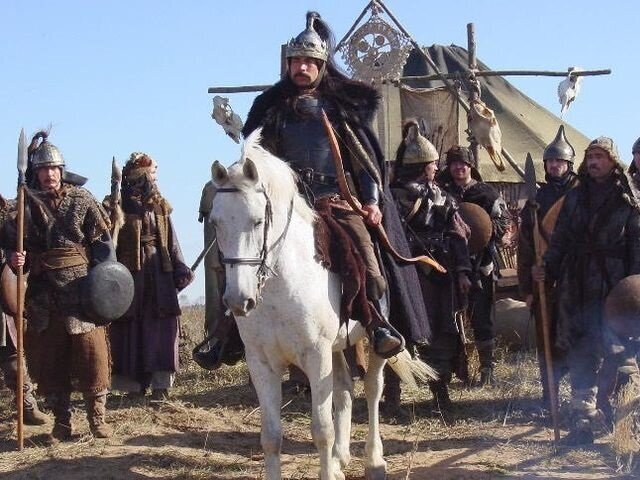
All these executions did not contribute to the consolidation of the Xiongnu society, which began to drift towards centrifugal sentiments. The next khan after Hulugu, Huyandi (meaning “Hare” in Turkic), from the royal and aristocratic Huyandi clan (apparently his mother named him after her clan), became a weak-willed weathervane, influenced by all the court cliques.
He had no clearly formulated concept of foreign policy and had to maneuver between court factions. This immediately led to a weakening of centralized power, and the khan ceased to intervene in inter-clan disputes. Because of this, entire clans began to flee to China, as the strong began to oppress the weak, and the shanyu was unable to resolve the situation peacefully through the courts.
The Chinese were no fools either and accepted the nomads, recruiting them into the cavalry. Instead of criminals, who did not really know how to ride, young Xiongnu, accustomed to steppe warfare since childhood, began to join the cavalry. This immediately strengthened the Chinese army.
The strengthened border guards of the Celestial Empire and Chinese customs began to crack down on the nomads so much that they could no longer freely and duty-free buy Chinese goods. But in general, this was a positive development for the Xiongnu, as the tribal elders realized that they now had no access to cheap Chinese goods, which meant they had to obtain them the old-fashioned way—through plunder. But plunder requires a strong army, and the tribal militias were clearly no match for the steppe Rambos. Only the professionals from the Modé tumens, who dreamed of war with the Chinese, were capable of this, but they had little strength. This strength was given to them by the Xiongnu clans, who became interested in dangerous but profitable warfare.
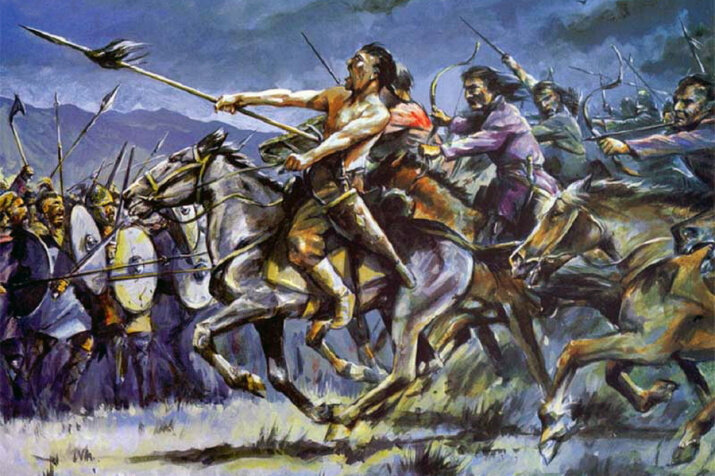
In 80 AD, the Xiongnu resumed their raids on China. But they were no longer opposed by Chinese convicts, whose punishment had been replaced by military service, but by their fellow tribesmen and representatives of other nomadic tribes, united by military discipline. The raids became dangerous, and in some of them the Xiongnu lost up to half of those who participated in the raid.
In addition, thanks to an organized signaling system (fires on high ground), the Chinese authorities received advance warning of danger and had time to retreat to their fortresses.
The Xiongnu’s failures immediately became known in the steppes (there was always an uzun-kulaq). The Dingling, Uighur, and Uisu tribes rebelled against them. There were not enough soldiers to subdue them again, as they were not being paid and began to leave to serve in China.
In addition, the Chinese shifted from defensive tactics to aggressive offensive ones. They were further driven by the need to gain control over the Great Silk Road. The only problem in this direction remained the Xiongnu and the small principality of Chesh in Turfan, which steadfastly resisted the Chinese satellites, as its main income came from the sale of agricultural products to nomads.
By this time, the Chinese had finally reached an agreement with the Wusun, who were interested in the possibility of jointly using the Great Silk Road, which passed through their lands.
In 72 BC, the Chinese army made a diversionary strike deep into the steppes. The Xiongnu easily escaped the Chinese cavalry and were already preparing beshbarmak in their yurts to celebrate another Chinese failure when 50,000 Wusun attacked them. The attack was so unexpected that they captured 39,000 prisoners and 700,000 head of cattle.
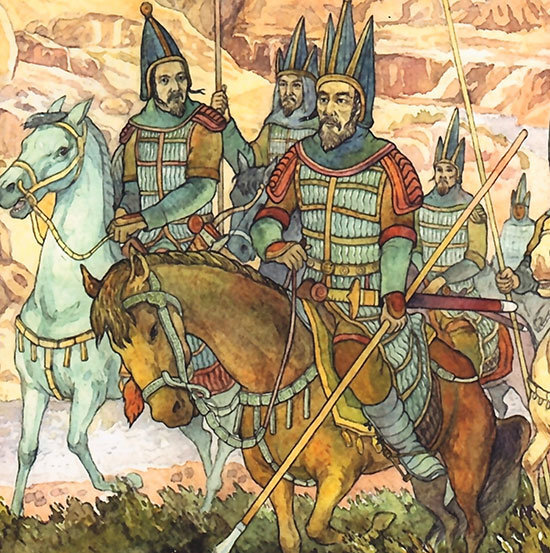
In response, the enraged Xiongnu invaded the Uisu’s lands in the winter of 72/71. The Uisu left their families behind and fled to the mountains — at that time, it was considered unacceptable to kill the weak. But the Xiongnu were so angry that they killed children and old people, which was wrong according to all the laws of the steppe. And karma immediately caught up with them — on their way back, they got caught in a blizzard and most of the army perished.
In the summer of 71, the Wusun, Dingling, and Uhuani entered the unprotected Hunnic settlements and completely plundered them. Shan Yu Huiandi was forced to keep his remaining two tumens of warriors on the border with China and had no way to repel the raids of other nomads. The Xiongnu were stripped of everything they had—silk, rice reserves, and Chinese prisoners.
The economic power of the Xiongnu state was undermined. Now it had no means to maintain a large state apparatus or a strong army. And there was nothing to collect taxes from—the nomads had become impoverished.
Thus ended the inglorious reign of the shanyu named Hare (Huyandi).
The next Shanyu, Xu Luyi, was a pragmatic man. He decided on a difficult step: in order not to lose the food supply for the Xiongnu horses, he resettled the farmers from Chesi to the east, to the Manchurian steppes. The territory of the principality went to the Chinese. Such a loss speaks to the complete disorganization of the Xiongnu state apparatus, since the Chinese had no need for the farmers of Chesi. They needed the territory of Chesi as a base for their caravans carrying silk to the west. The steppe intelligence service, which had previously been so knowledgeable about the situation in China, failed to analyze this, which speaks to its very poor performance (as well as that of the entire state apparatus).
Thus, China effortlessly gained control over the entire steppe section of the Great Silk Road. And it began to reap fabulous profits from the caravan trade. But if the Xiongnu had held on to Chesi with all their might, they could have at least had a trump card in their hands against the Celestial Empire (and not only a trump card, but also a good profit from the caravans). But the Xiongnu did not understand the situation, which allowed China to grow stronger.