

The revival of the Xiongnu
The Xiongnu grew extremely powerful during the period of anarchy that lasted until 47 AD. Their nomadic tribes crossed the Great Wall, and the Chinese authorities were forced to liberate the northern border areas on their own for the first time, resettling the population deeper into the country.
Dynastic struggle
The Xiongnu were doing well in foreign policy. However, problems began to arise domestically.
Shan Yu Yu was not the direct heir of the legitimate Shan Yu Huhanye, who became a vassal of the Chinese emperor. Huhanye had numerous descendants, who were a thorn in Yu’s side.
Huhanye’s main heir was a half-breed from the Chinese princess Zhasi, whom Yue killed. This outraged Huhanye’s descendants and united them under the leadership of another descendant of Huhanye, Bi.
After Yu’s death in 47 AD, Bi proclaimed himself shanyu and was supported by eight of the 24 Xiongnu clans. These eight clans recognized the suzerainty of Emperor Han Guangwu and began to guard the border from their fellow tribesmen.
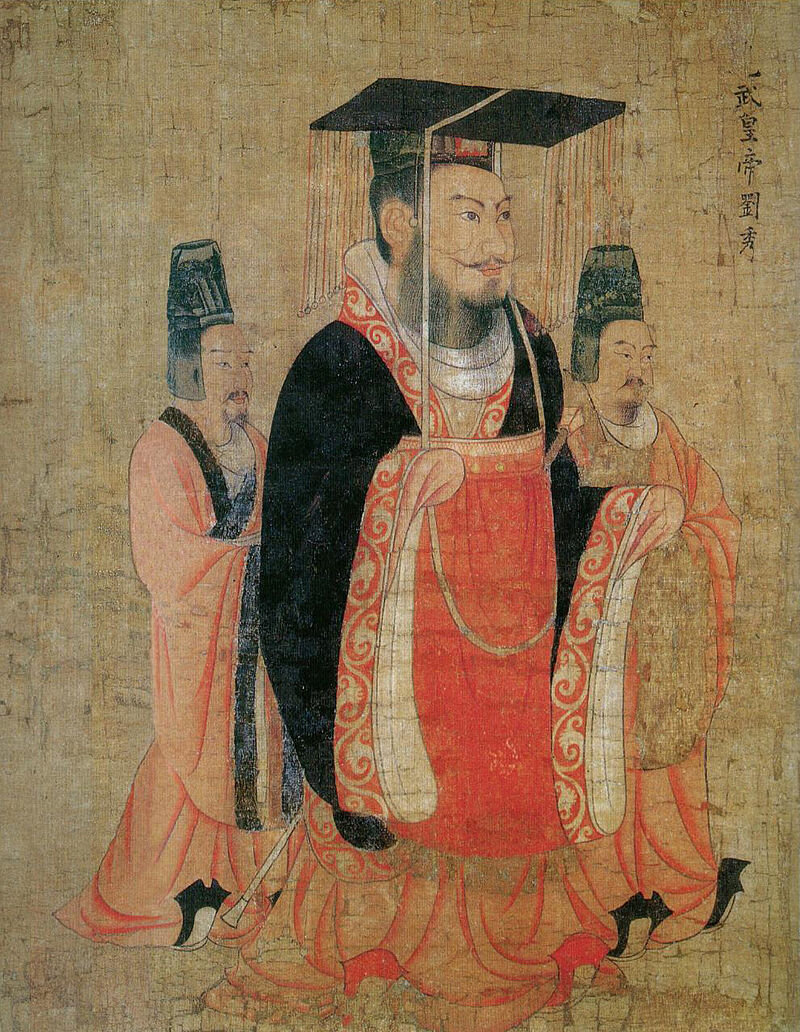
Guanwu-di (5 BC — 57 AD), adult name Liu Wenshu, was emperor of China from 25 to 57 AD. He was the first emperor of the late Han Empire.
The legitimate shanyu Punu (son of Yu) remained to rule in the northern steppes. Also, after the departure of the eight clans, the Xiongnu decided to break away from the Xiongnu empire and stopped paying tribute.
In 49, the pro-Chinese shanyu Bi attacked Punu and forced him to flee to modern-day Halh. Since then, the free Xiongnu have been called the Northern Xiongnu, and those vassal to China have been called the Southern Xiongnu.
After that, things went very badly for the Northern Xiongnu: one clan was completely destroyed by the Xianbei, two clans went to the Southern Xiongnu, and the Xiongnu lost control of Manchuria.

Punu was the shanyu of the Xiongnu from 46 to 52 (?). He was the son of Yu. He was unable to suppress Bi’s rebellion. The Xiongnu empire split into northern and southern parts. He remained to rule in the north.
But things were not going well for the southern Xiongnu either. The shanyu’s duty to receive all the emperor’s messages by bowing down to the floor caused discontent among the ordinary nomads. Because of this, five clans rebelled against Bi in the winter of 50/51, and he was forced to call on the Chinese for help. This did not add to his popularity.
After that, the clans began to move from the northern to the southern Xiongnu and back again. The Xiongnu destroyed each other — some attacking Chinese lands, while others defended them.
Tibetan affairs
Strategically, it was more important for the Xiongnu to establish an alliance with the Tibetan Kyan than to raid China. They had been fighting a long battle with Chinese officials and their armies of pardoned criminals on the western border.
In 58 AD, the Kyan resistance was finally suppressed, and those who did not want to submit to China fled to the mountains.
But the Chinese, after analyzing the causes of the uprising in Tibet, came to the conclusion that the border officials were to blame. They were executed, and administrative power was transferred to the elder of the Kyan clan, Shaodan-Tianwu. For the Tibetans, this meant de facto independence.
Thus, the Tibetans, having united, finally achieved independence, while the Xiongnu began their path to enslavement. Yet they had a chance to join forces with the Kyans and, by closing the way to the Western Region for the Chinese, become the hegemons of the Great Silk Road.
Western affairs
During the civil strife in China at the beginning of our era, the power of Yarkand in modern East Turkestan grew extremely strong, and by 57 AD it had conquered the entire former Chinese Western Region.
The Yarkand people were cruel to others, and so in 57 AD, Hotan rebelled and overthrew Yarkand’s rule. Then other settlements also freed themselves from its power. In Yarkand itself, the local ruler, Hyan, was killed as a result of a conspiracy.
Taking advantage of this, the Xiongnu captured the entire Western Region and began to receive tribute in the form of goods and fodder. From this territory, the Xiongnu also began to make constant raids on Chinese lands, which forced them to capture the Hami oasis on their way in 73 AD. The Xiongnu did not pay attention to this, but in vain — it was Hami that became the base for the further advance of the Chinese in the region.